Claude Opus 4.5: The New Leader in AI Coding with 80.9% SWE-Bench
Alexandra Bezea-Tudor,Marketing Specialist
Claude Opus 4.5 sets a new standard for AI-assisted software engineering, achieving the highest score ever recorded on SWE-Bench Verified while delivering unmatched coding efficiency, multi-language versatility, and seamless integration into real-world developer workflows.
80%+ on SWE-Bench V: Claude Opus 4.5 Sets Unprecedented Coding Benchmark
What Makes Claude Opus 4.5 Anthropic's Best Model?
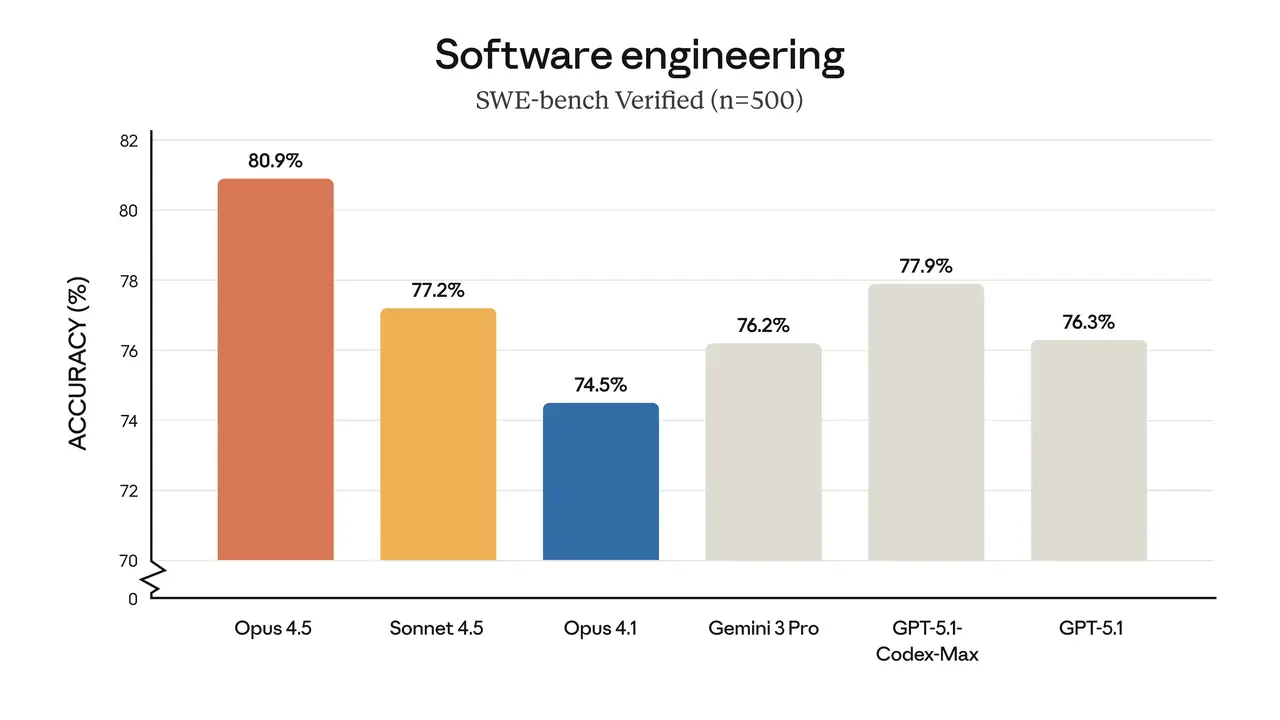
Anthropic has officially released Claude Opus 4.5, their most intelligent model to date. Opus 4.5 has achieved an impressive 80.9% on the SWE-Bench Verified coding benchmark, surpassing human engineers and outperforming competitors like GPT 5.1 and Gemini 3 Pro. Designed for professional software engineering, complex agentic workflows, and demanding enterprise tasks, Opus 4.5 raises the question: can any LLM match this level of coding skill? Internal tests show strong coding proficiency, with industry experts noting its impressive problem-solving capabilities on complex coding tasks.
How Well Did Opus 4.5 Perform on the SWE-Bench Verified?
Claude Opus 4.5 achieved an 80.9% score on SWE-Bench Verified, a benchmark that evaluates software engineering skills in solving real-world GitHub issues, surpassing human engineers and outperforming competitors like GPT 5.1 (76.3%) and Gemini 3 Pro (76.2%) (Anthropic, 2025).
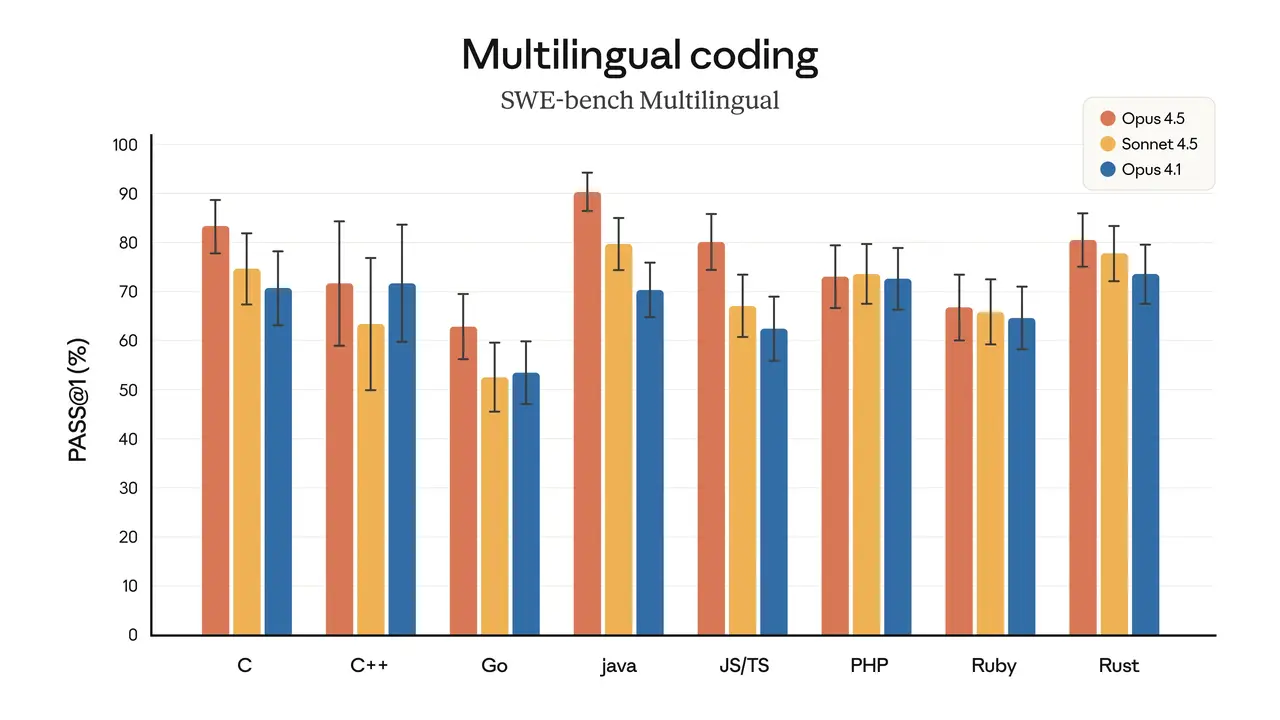
Notably, Opus 4.5 also leads across 7 of 8 programming languages in the SWE-Bench Multilingual evaluation, and scores 89.4% on the Aider Polyglot Coding benchmark, demonstrating both depth and versatility in software development.
SWE-Bench Verified: 80.9% (highest among competitors)
Token efficiency (Medium effort): matches Sonnet 4.5's score on SWE-Bench Verified while using 76% fewer tokens
Token efficiency (Maximum effort): Exceeds Sonnet 4.5 by 4.3 percentage points while consuming 48% fewer tokens
Opus 4.5 tops SWE-Bench Verified with 80.9%Opus 4.5 ranks #1 in 7 of 8 languages on SWE-Bench Multilingual
How Does Opus 4.5 Enhance Coding Efficiency?
Opus 4.5 introduces several improvements that enhance coding efficiency and planning, especially for multi-step and complex tasks. Its capabilities include:
Token Efficiency: It solves coding tasks with significantly fewer tokens than previous models, reducing computational cost and improving speed (Anthropic, 2025).
Effort Parameter: Developers can fine-tune the balance between output quality and token usage, choosing to minimize time and spend or maximize capability (Ars Technica, 2025).
Context Management / Memory: Enhanced long-context performance and more reliable memory handling during complex workflows (TechCrunch, 2025).
How Does Opus 4.5 Fit Into Real-World Workflows?
Opus 4.5 extends beyond coding with practical integrations that enhance productivity:
Claude for Chrome: Claude handles tasks across browser tabs, now available to all Max users.
Claude for Excel: Expanded beta access to Max, Team, and Enterprise users
Opus 4.5’s strong performance in computing, spreadsheet handling, and long-running tasks makes these updates highly practical for enterprise teams across diverse applications.
Why Is Opus 4.5 a Game-Changer for AI-Assisted Software Development?
Claude Opus 4.5 doesn’t just improve on previous models; it redefines what AI can do in software engineering. Can any other model match its coding performance, efficiency, and multi-language versatility? With enterprise-ready integrations that put this power directly into developers’ hands, Opus 4.5 moves AI from assistance toward true collaboration, offering a glimpse of the future of AI-assisted software development.