What Is Synthetic Data, Really? A 2025 Guide to the Invisible Threads That Teach Machines to See
Tatiana Zalikina,Director of Growth Marketing
Some synthetic-data APIs are polite illusionists: they conjure extra samples, smile sweetly, and hope you won’t notice the inconsistencies hiding behind the curtain. Others are industrial-grade simulators wrapped in an HTTP endpoint, running entire micro-worlds so your model can learn without burning real daylight.
2025 Guide: Choosing the Right API-Key Synthetic Data Generator for AI Models
What Is Synthetic Data, Really? A 2025 Guide to the Invisible Threads That Teach Machines to See
Have you ever wondered what it feels like to fill a library with books no human ever wrote, but surprisingly all of them make sense? That’s synthetic data: a landscape built not from lived experience but from intelligent invention. It’s not “fake data.” It’s crafted reality for machines, created so AI can learn without stepping on anyone’s privacy, without waiting years for doctors to label images, without needing a mountain of rare cases that never seem to show up in the real world.
In 2025, synthetic data is no longer a fringe gadget. It’s one of the foundational pillars of AI systems alongside models and compute, shifting how we build intelligence.
Let’s walk through this like friends walking through a garden: curious, a bit skeptical, enchanted by the flowers, and occasionally poking the soil with a question.
What Is Synthetic Data? (Not “fake,” but functional)
In the simplest terms, synthetic data is artificially generated information that mimics real-world data without containing real personal or sensitive examples. You train a model on real data and then churn out new examples that behave like the originals but aren’t tied to any actual person.
Think of it like this:
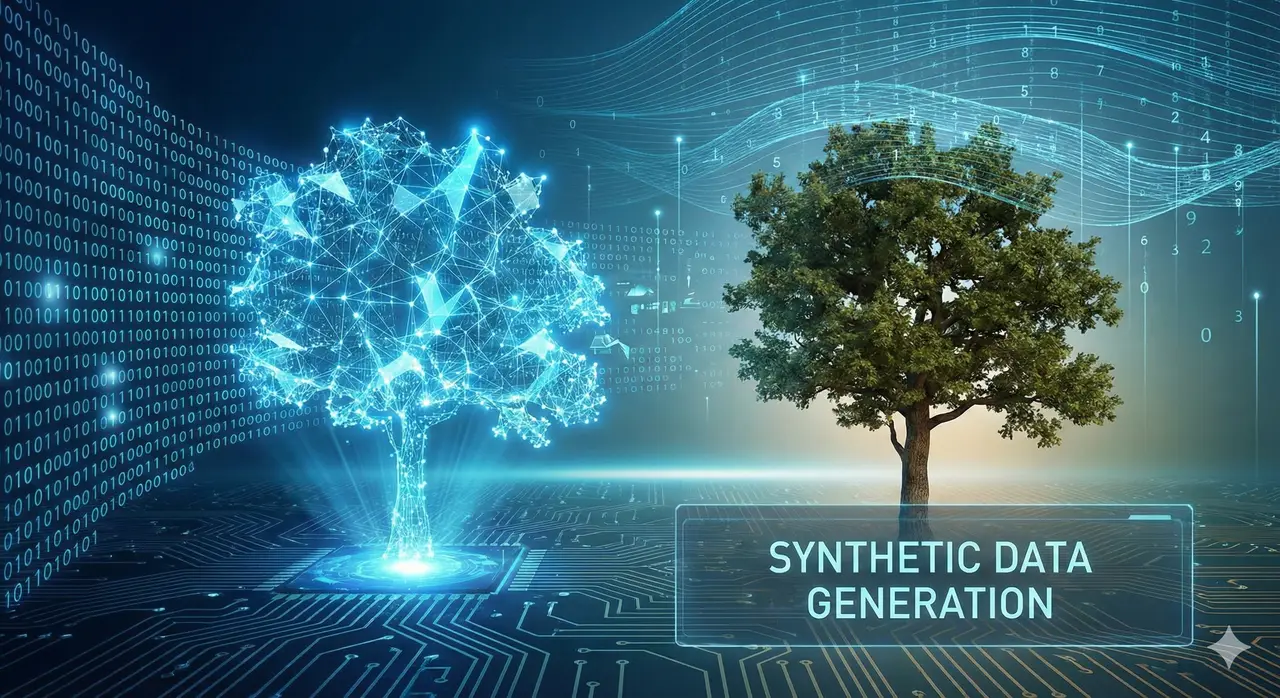
If real data is the oak tree in your backyard, synthetic data is the forest you plant from its seeds, same species, same forest feel, but not that exact oak.
Same statistical shape. Same patterns. None of the actual acorns your neighbor’s kid dropped last summer.
Why do we do it? Because real data carries baggage: privacy laws, access limitations, ethical thorns. Synthetic data sidesteps all of them while still empowering AI to learn.
The Heartbeat of Synthetic Data: How It’s Made
Like a good story, synthetic data has many narrators; some whisper and others shout. The key technologies fall into distinct categories:
Generative Deep Learning (GANs & Friends)
Generative Adversarial Networks (GANs) are like a painter and a critic in perpetual rivalry: the painter (generator) tries to make data that looks real, while the critic (discriminator) tries to spot the fakes. Through this tension, they gradually produce remarkably realistic outputs.
GANs are especially strong for images, videos, and other structured, high-dimensional data. They can learn the essence of what makes an image “look right” and then weave new ones that follow all the same rules.
Why it matters: GAN-generated synthetic data can closely mimic complex distributions, giving models realistic training input without exposing any real sensitive information. The sheer realism can make models robust, but this technique can be temperamental to train.
Variational Autoencoders (VAEs)
If GANs are artistic rivalries, VAEs are the careful archivists. They compress data into a learned representation and then reconstruct it, generating new examples that follow the same statistical structure.
When to use them: VAEs shine in scenarios where you want smooth variation and mathematical interpretability, for example, when modeling sensor data or multi-feature tabular sets.
They tend to produce slightly blurrier outputs than GANs in visual tasks, but they’re great when you need control and structure.
Programmatic and Rule-based Synthesis
Synthetic data doesn’t always need a deep neural network. Some methods use domain rules and simulation engines to craft data.
This might involve physics-based models, agent-based simulations (e.g., traffic flows), or logic-solvers that ensure the synthetic samples obey specific constraints.
Example: Simulating robotic behavior in a factory with realistic motion paths, collision frequencies, and sensor feedback, all without a single real hour of production data.
Synthetic data often joins forces with privacy-preserving techniques like differential privacy (DP) so that even statistical inference can’t expose sensitive information. A 2024 study on SafeSynthDP shows that integrating DP into generative models retains utility while defending against membership inference attacks.
This is critical in domains like healthcare and finance, where you want synthetic datasets that are both useful and safely inscrutable.
The OECD’s 2025 report confirms that applying techniques like differential privacy within synthetic data generation can help organizations share AIable data without risking individual re-identification, a boon for cross-institutional collaboration.
Synthetic Data Generation Epitomised
A Working “Synthetic Data Pipeline”
Walking through a synthetic data workflow, you should feel like watching a chef at work...not robotic, but creative and methodical.
Understand the Domain. Talk to experts. You need rules, edge cases, and hidden constraints.
Choose Methods Wisely. GANs? VAEs? Simulation? Or a blend?
Generate at Scale. Create enough synthetic samples to capture variation and edge conditions.
Validate Quality. Use metrics (like distribution similarity or proxy performance) to check that the synthetic resembles the real sufficiently.
Blend with Real Data (Optional). A mix often yields the best results.
Deploy and Monitor. Watch for bias, drift, or performance holes.
One study emphasizes that synthetic data alone is not a perfect replacement for real data, but it’s a strategic complement when thoughtfully integrated. It boosts robustness, diversity, and generalizability in data-scarce environments.
Why Synthetic Data Matters in 2025
We’re not talking about a cute side trick. We’re talking about a fundamental shift in how we train, test, and scale AI.
Privacy by Design
Scale on Demand
Versatility Across Modalities
From text to tabular sequences to images and simulations, synthetic data spans modalities. LLMs can generate realistic text corpora or structured logs for NLP tasks; GANs and VAEs handle visual domains; simulations craft sensor or physics data.
When Synthetic Data Works Best
Like rain for a desert flower, synthetic data blooms most vividly in certain contexts:
Data Scarcity When real labels are hard to come by or too costly to get.
Privacy or Compliance Barriers When regulations block you from using real datasets.
Rare Events & Edge Cases When real data rarely produces the events you need (e.g., fraud patterns, rare diseases).
Pre-Testing & Simulation When you want to explore “what if…?” without risking real outcomes.
The key isn’t replacement, but augmentation, synthetic data complements reality by filling gaps and broadening scenarios.
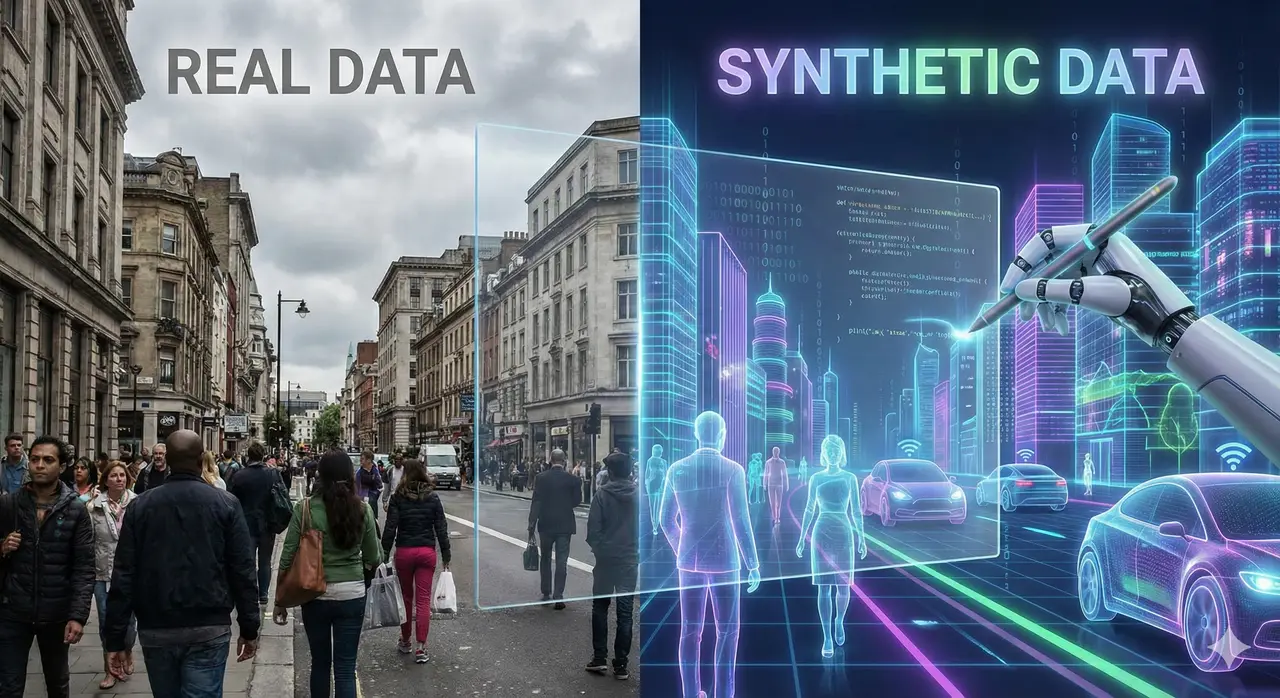
Synthetic Data Mirrors the Real World
The Real Limitations (Yes, ThereAreSome)
No fairy tale is complete without a touch of reality.
Despite its elegance:
- Synthetic data quality depends on the quality of the models and rules used to generate it.
- If your generator was trained on biased data, your synthetic set may inherit that bias.
- Some generative techniques, especially GANs, can produce artifacts or overfit small original datasets.
- And, as industry analysts caution, relying only on synthetic data can lead to model degradation over long training cycles if not balanced with real data sources.
That’s why careful validation, hybrid approaches, and human-in-the-loop evaluation are critical to trustworthy synthetic workflows.
How Abaka AI Contributes to the Synthetic Data Landscape
At Abaka AI, we generate synthetic data and treat it as an ergonomic partner to real data. Here’s how we help:
✨ Holistic pipelines. We integrate synthetic data generation into annotation workflows with a feedback loop that refines both artificial and real data quality.
✨ Rigorous privacy measures. Differential privacy and advanced anonymization ensure synthetic outputs uphold compliance by design.
✨ Multimodal support. From text corpora to structured analytics, images to simulation traces, our systems generate data that speaks the language of your models.
✨ Iterative validation frameworks. We measure usefulness continuously, ensuring synthetic samples improve performance without unknowingly introducing bias.
Because in 2025, synthetic data isn’t a shortcut but a craft.
Imagine This…
Picture your AI model as an inexperienced painter. Real data gives it color palettes. Synthetic data gives it imaginary landscapes, dramatic skies, and rare light conditions. Together, they teach it not just to reproduce reality but to understand it.
It’s not random.
It’s designed.
It’s intentional.
And it is rapidly becoming a cornerstone of AI development, not because it’s flashy, but because it works.
If you want your model to work too, contact us, and we will run you through solutions tailored for your model!