From Chatbots to Operators: The Rise of AI Agents, FDM-1, and the OpenClaw Ecosystem
Jessy Abu Khalil,Director of Sales Enablement
AI is shifting from chatbots that generate responses to agents that execute tasks.
Recent innovations from companies like Anthropic, Cursor, and Perplexity demonstrate how modern AI systems can plan, act, and operate software environments autonomously. These agent-based systems combine reasoning, tool usage, and memory to perform complex workflows—effectively transforming large language models into self-running computers capable of acting as digital operators.
In short: chatbots answer questions, but AI agents complete work.
From Chatbots to Operators: Why AI Agents and OpenClaw Systems Are Becoming Self-Running Computers
For years, AI assistants functioned primarily as chatbots~systems that generated text responses when prompted. But a new paradigm is emerging: AI agents that can operate computers autonomously.
Recent developments from companies like Anthropic, Cursor, and Perplexity signal a rapid transition from conversational AI to operational AI:
Anthropic’s Claude is evolving toward autonomous agent workflows.
Cursor Cloud Agents allow AI to run development tasks asynchronously.
Perplexity Computer introduces AI systems that can directly operate software.
In short, AI is moving from answering questions to executing tasks. The next generation of systems are becoming self-running computers capable of reasoning, planning, and acting within digital environments.
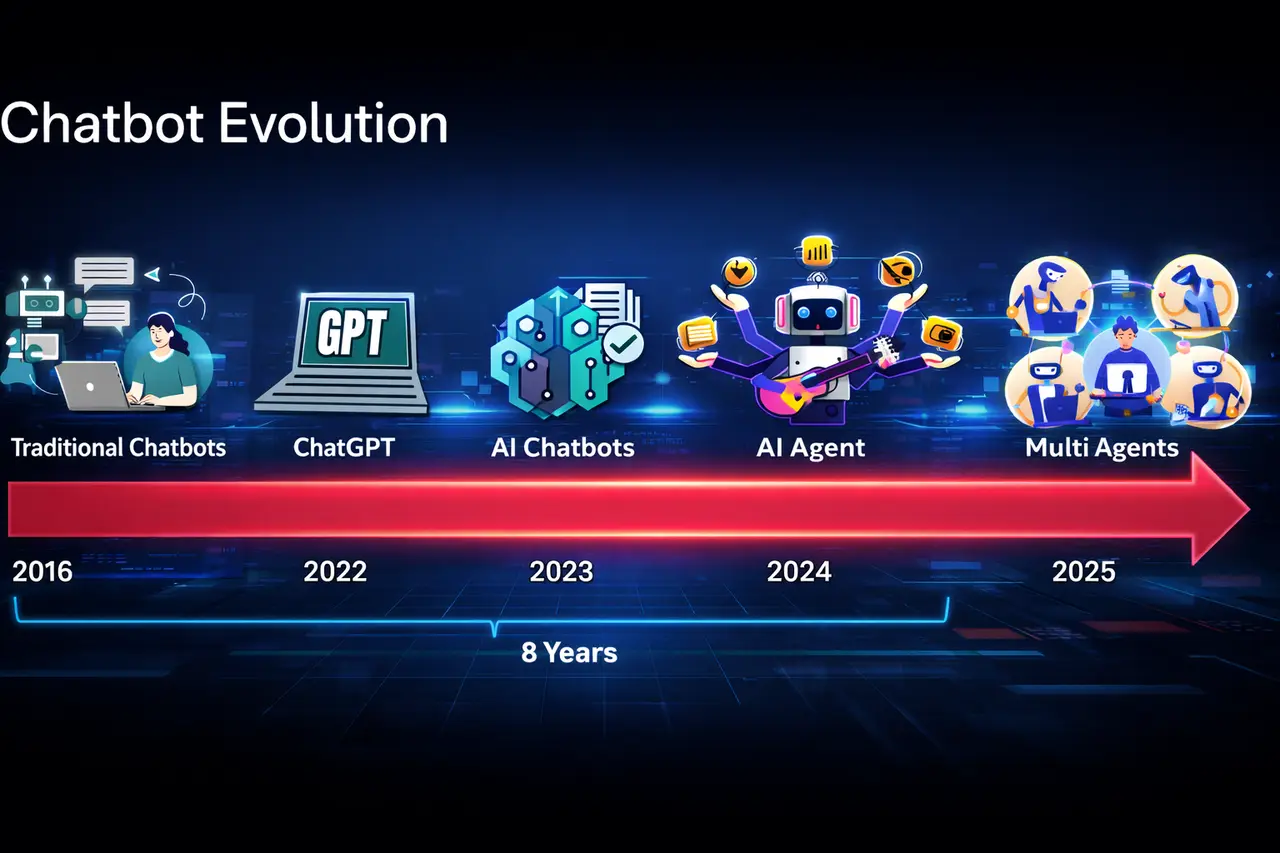
The Evolution: From Chatbots to Autonomous Operators
Chatbot Evolution Over the Past 8 Years
Traditional chatbots relied on a simple loop:
User asks a question
AI generates a response
Interaction ends
AI agents introduce a continuous reasoning loop:
Perceive: Observe environment or task
Reason: Plan steps to accomplish goal
Act: Use tools, APIs, or software
Evaluate: Adjust plan based on results
This structure is often called the agentic loop.
According to a 2024 McKinsey AI report, organizations implementing agent-based automation can reduce complex workflow time by 30-60% compared to traditional automation tools.
The key difference is not intelligence, but agency and autonomy.
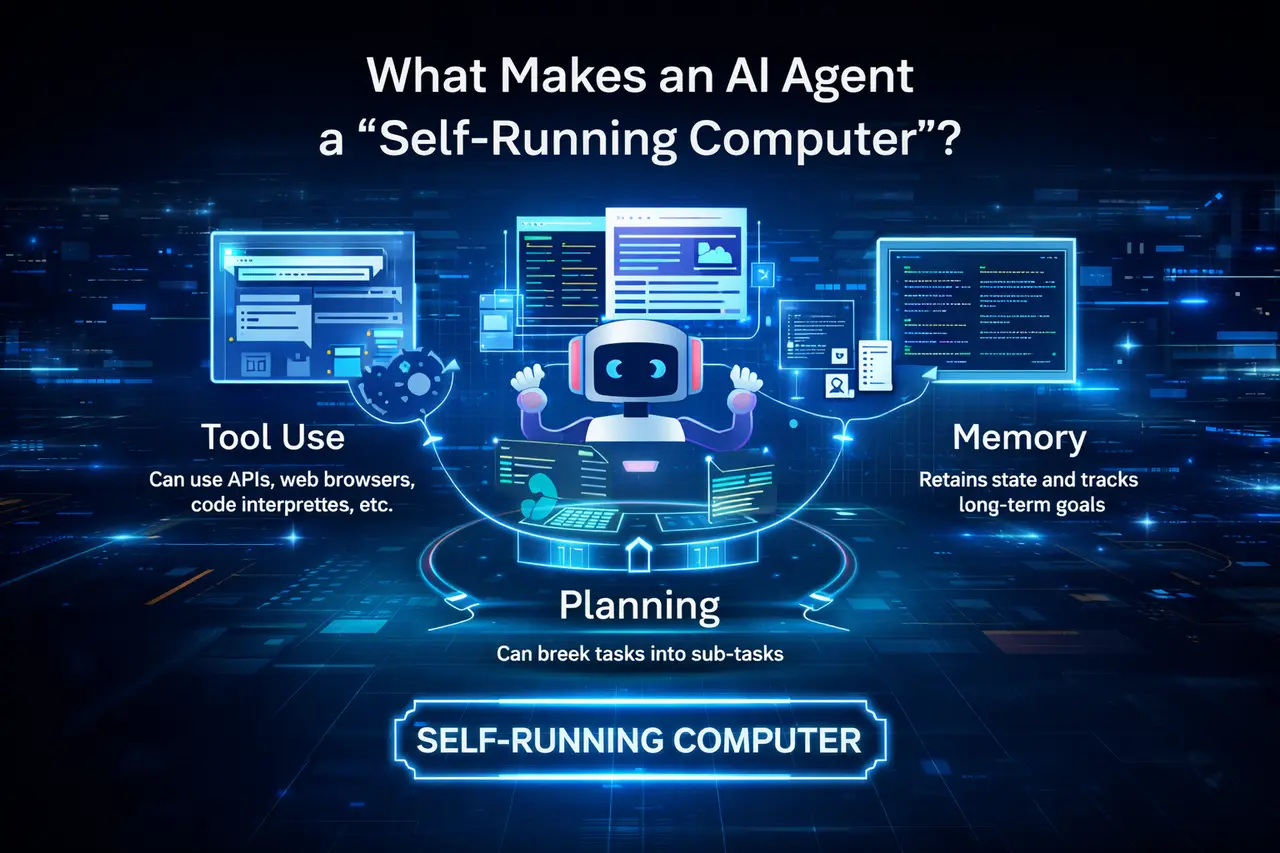
What Makes an AI Agent a “Self-Running Computer”?
AI agent using tools, planning, and memory to run software
A system becomes a self-running computer when it can autonomously operate digital environments.
Three capabilities enable this shift:
1. Tool Use
Modern LLMs can call tools such as:
Web browsers
Code interpreters
APIs
Databases
OpenAI’s function-calling architecture and similar frameworks allow models to interface with software like human operators.
Tool-augmented reasoning significantly improves success rates on complex tasks in multiple AI benchmarks.
2. Planning and Task Decomposition
Agent systems break problems into sub-tasks.
Example workflow:
Goal: Deploy a website.
Agent steps:
Generate code
Run tests
Fix errors
Deploy infrastructure
Monitor logs
Cursor’s new Cloud Agents automate large portions of software development this way.
Developers report productivity improvements of 2-4× when AI agents assist in coding workflows.
3. Persistent Memory
Chatbots forget conversations after the session ends. Agents maintain state and memory across tasks.
This allows systems to:
track long-term goals
remember prior outputs
update strategies
Research from DeepMind shows memory-augmented agents achieve up to 3× higher performance on long-horizon planning benchmarks.
Real-World Systems Leading the Agent Revolution
Claude Agents (Anthropic)
Claude’s new capabilities emphasize computer-use autonomy, where the model can interact with software interfaces directly.
These systems can:
navigate dashboards
run terminal commands
execute workflows
Industry analysts describe this shift as “AI operators” replacing manual digital labor.
Cursor Cloud Agents
Cursor’s platform allows developers to delegate tasks such as:
debugging repositories
writing tests
refactoring codebases
Instead of responding interactively, agents run tasks asynchronously in the cloud.
This moves AI from assistant to collaborator.
Perplexity Computer
Perplexity’s system aims to build an AI-native operating environment.
Instead of opening apps manually, users describe goals:
“Research competitors and generate a presentation.”
The agent then:
Collects data
Writes content
Creates slides
In short: the AI becomes the operating system.
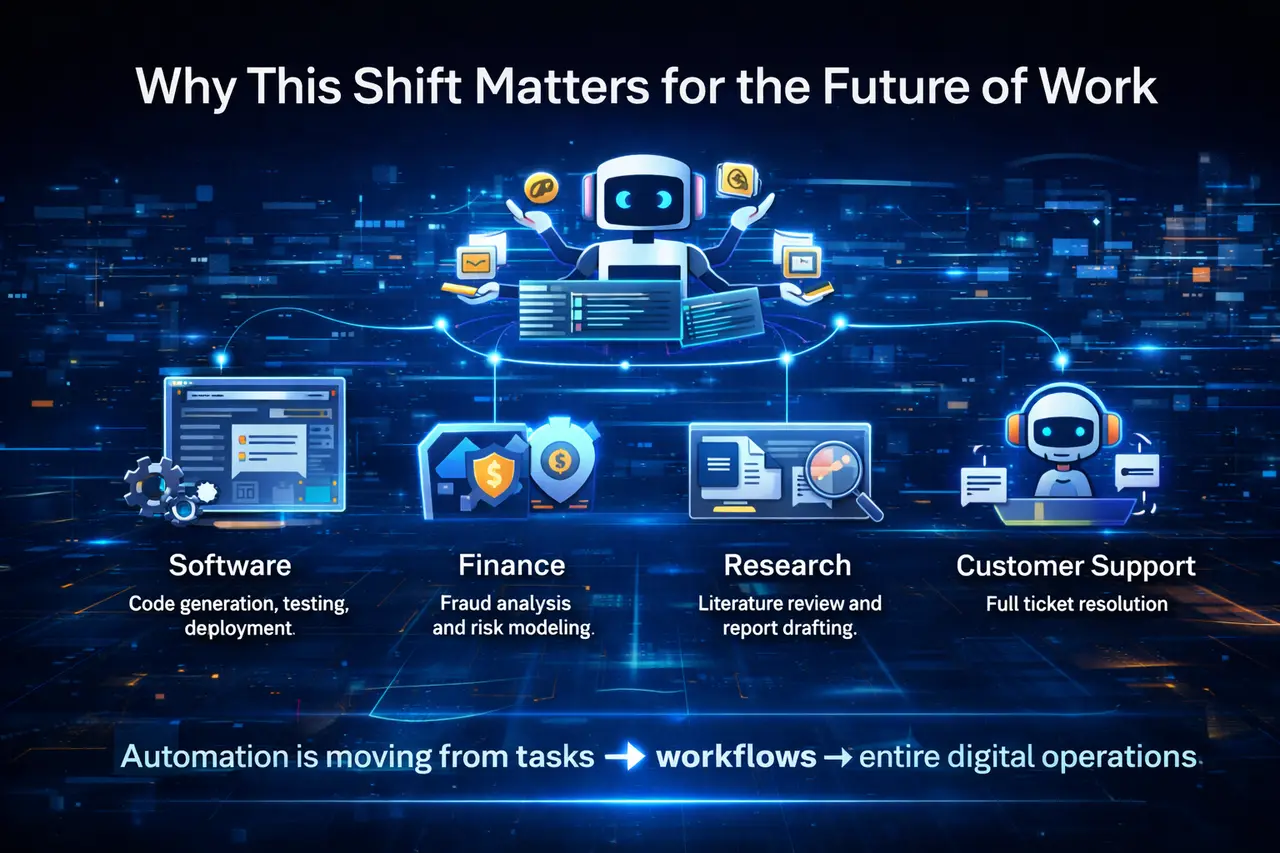
Why This Shift Matters for the Future of Work
AI agents automating workflows across industries
Agentic systems are transforming knowledge work.
A 2024 Goldman Sachs report estimates that generative AI could automate up to 25% of current work tasks globally.
But agent-based systems push this further by automating multi-step workflows.
Examples include:
Industry
Agent Workflow
Software
Code generation, testing, deployment
Finance
Fraud analysis and risk modeling
Research
Literature review and report drafting
Customer support
Full ticket resolution
Summary: Automation is moving from tasks → workflows → entire digital operations.
The Role of Human Feedback in Training AI Operators
Even autonomous agents require human-in-the-loop training.
Techniques like Reinforcement Learning from Human Feedback (RLHF) remain critical.
Human evaluators help models learn:
task correctness
safety boundaries
decision reasoning
Companies building advanced agents rely heavily on human evaluation datasets and benchmarking pipelines.
Without structured evaluation, agents risk:
hallucinated actions
unsafe operations
unreliable automation
Key Challenges Facing Autonomous AI Agents
Despite rapid progress, autonomous AI agents still face several technical and operational limitations. The table below summarizes the most significant challenges.
Challenge
Description
Examples / Evidence
Reliability
Autonomous agents often struggle with complex, long-horizon tasks that require many sequential steps. Small reasoning errors can compound over time and cause task failure.
Research from Epoch AI shows many agents struggle with tasks requiring more than 20 sequential steps.
Safety
Agents with access to systems, files, or APIs can introduce security risks if safeguards are not in place.
Potential issues include unintended file deletion, executing malicious code, and leaking sensitive data. This is why AI red-teaming and adversarial testingare increasingly important.
Evaluation
Measuring agent performance is more difficult than evaluating traditional chatbots because success depends on completing multi-step workflows.
Evaluation must consider task completion, efficiency, and reliability across environments. New benchmarks such as agentic task environments are emerging to address this.
What Comes Next: AI as the Operating Layer of the Internet
The future trajectory is clear:
AI will increasingly act as the interface between humans and software.
Instead of navigating apps ourselves, we will describe goals:
“Analyze our sales data and prepare a report.”
The agent will coordinate tools, data, and workflows automatically.
In short:
Chatbots answered questions.Agents will run computers.
Interested in building or evaluating AI agents and next-generation LLM systems? 📩Contact our team to learn how we support leading AI companies with human evaluation, red teaming, and high-quality training data.
What's your data bottleneck this quarter?
Missing data
We collect it.
Messy data
We label it.
No time
We have itOff-The-Shelf.
Pick the closest fit, we'll take the call from there.