Human-in-the-Loop Examples: 5 Real AI Workflows That Still Need Humans in 2026
Jessy Abu Khalil,Director of Sales Enablement
In 2026, AI systems may operate at scale, but they do not operate alone. From LLM red teaming and medical diagnostics to fraud detection and autonomous vehicles, high-stakes AI workflows still depend on structured human oversight to ensure accuracy, safety, compliance, and accountability. The most successful AI deployments are not fully autonomous, they are strategically human-guided.
Human-in-the-Loop Examples: 5 Real AI Workflows That Still Need Humans in 2026
Artificial intelligence has automated everything from customer support to code generation. Yet in 2026, the most reliable AI systems still depend on human-in-the-loop (HITL) workflows.
According to a 2024 report by McKinsey & Company, over 55% of enterprises deploying AI at scale maintain structured human review layers to mitigate risk and improve accuracy. Similarly, research from Stanford HAI shows that human oversight improves factual accuracy in high-stakes domains by 15–40%, depending on task complexity.
In short, AI excels at scale and speed, but fails when context, judgment, and accountability are required. Below are five real AI workflows that still require human involvement in 2026, backed by case studies, data, and industry reports.
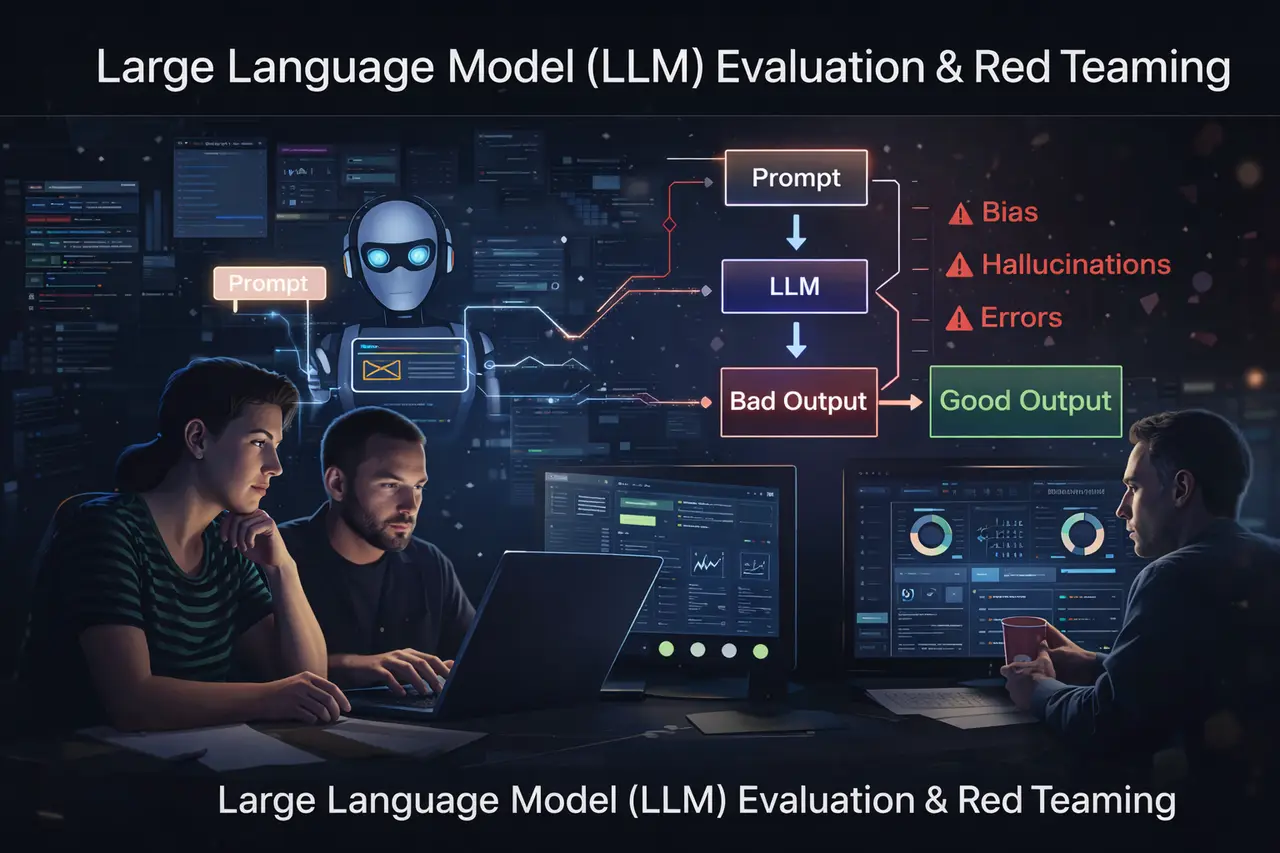
1. Large Language Model (LLM) Evaluation & Red Teaming
Large Language Model Evaluation & Red Teaming
Use case: Evaluating hallucinations, bias, and reasoning reliability in LLMs.
Despite rapid improvements, LLMs still hallucinate. A 2023 evaluation by OpenAI found that GPT-4 reduced hallucination rates by ~40% compared to GPT-3.5, yet non-trivial factual errors persist in open-domain queries.
Organizations now deploy human reviewers to:
Grade reasoning quality
Stress-test adversarial prompts
Benchmark outputs against domain gold standards
Provide RLHF feedback
In the coding domain, comparative benchmarks discussed in analyses like Google’s existential threat: ChatGPT vs Search show that while AI matches or exceeds search engines in certain tasks, human validation remains essential for production reliability.
Summary statement:LLMs scale reasoning, but humans validate truth.
Why humans remain essential
Automated metrics (BLEU, ROUGE, perplexity) correlate poorly with real-world helpfulness.
Safety evaluation requires normative judgment.
Adversarial creativity is still predominantly human-driven.
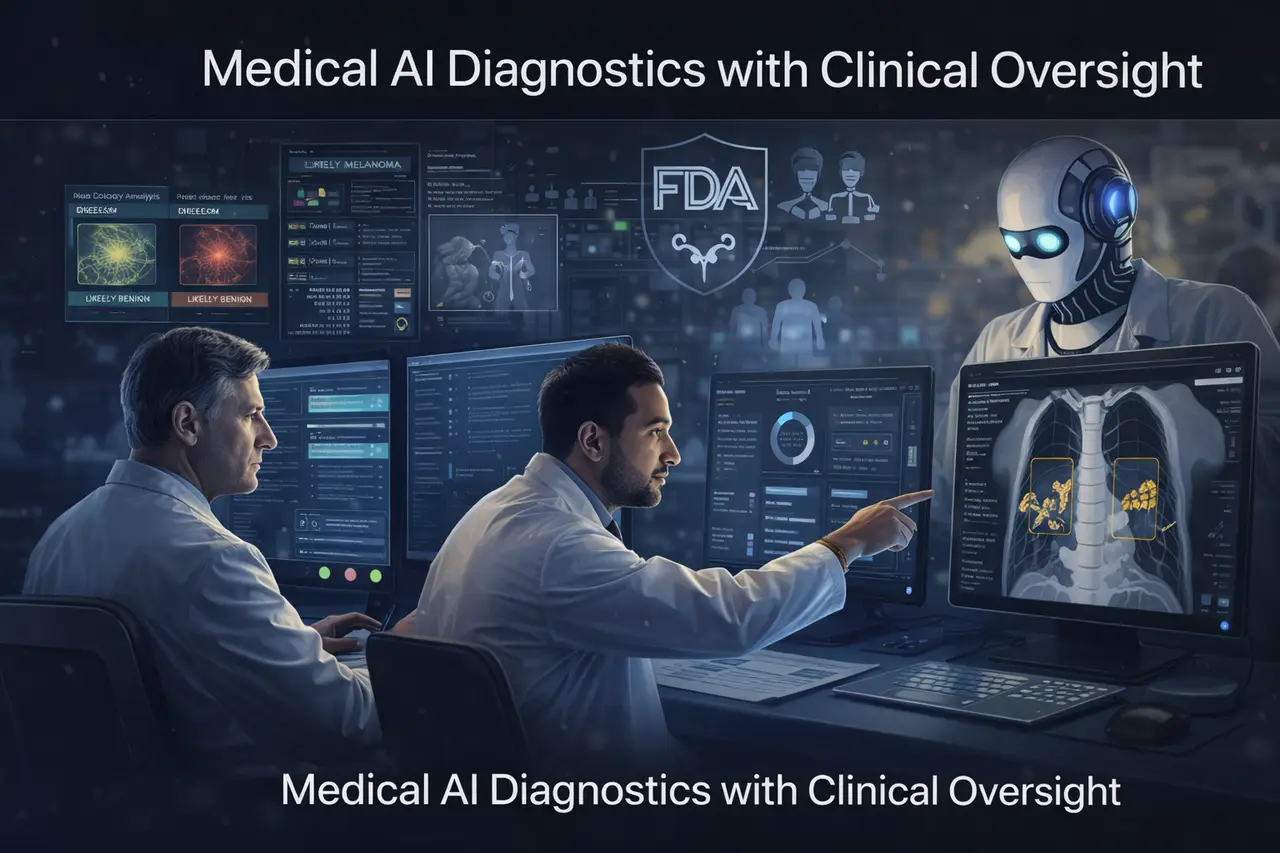
2. Medical AI Diagnostics with Clinical Oversight
Medical AI diagnostics with Clinical Oversight
Use case: AI-assisted radiology and pathology diagnostics.
A landmark study published in Nature Medicine (Esteva et al.) showed dermatology AI systems achieving dermatologist-level classification accuracy (~72–76% top-1 accuracy in multi-class tasks). However, subsequent hospital deployments revealed real-world variance due to demographic bias and imaging quality differences.
The U.S. FDA has approved over 500 AI-enabled medical devices, yet nearly all operate under a physician-in-the-loop framework, according to the FDA’s 2024 AI/ML device report.
The key difference between experimental AI and clinical AI is not model performance, but liability and patient safety.
Why humans remain essential
AI struggles with rare edge cases.
Ethical responsibility cannot be automated.
Human clinicians integrate patient history and contextual nuance.
3. Financial Fraud Detection & Risk Review
Financial Fraud Detection & Risk Review
Use case: Detecting anomalous financial transactions.
According to PwC’s Global Economic Crime Survey, organizations using AI-based fraud detection reduce detection time by up to 50%, but false positives remain high; sometimes exceeding 5–10% of flagged transactions in retail banking.
That’s where human analysts intervene:
Reviewing suspicious transactions
Escalating high-risk cases
Interpreting contextual financial signals
Ensuring regulatory compliance
In short, AI flags patterns; humans judge intent.
Why humans remain essential
False positives damage customer trust.
AML (Anti-Money Laundering) laws require explainability.
Complex fraud schemes adapt faster than static models.
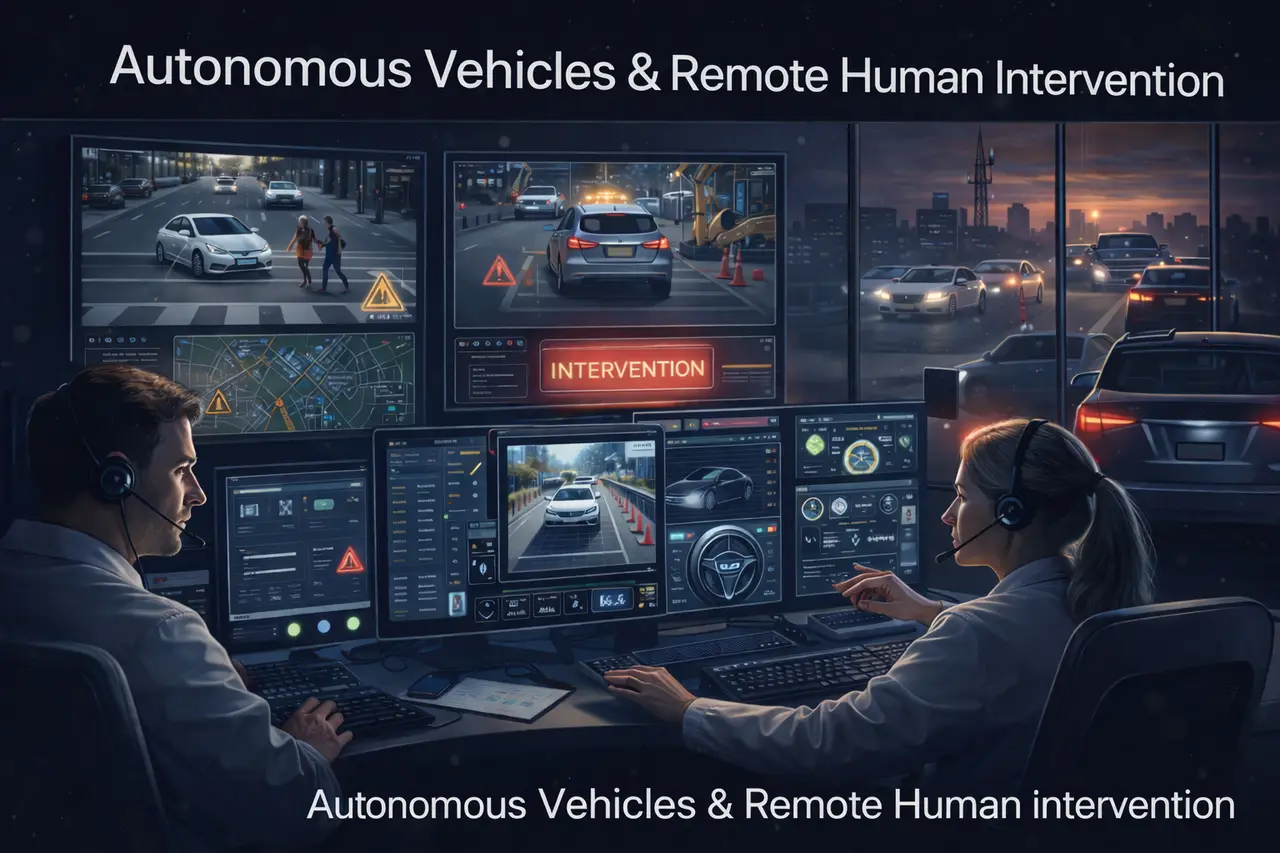
4. Autonomous Vehicles & Remote Human Intervention
Autonomous Vehicles & Remote Human Intervention
Use case: Edge-case driving interventions.
Companies like Waymo and Tesla rely on extensive human oversight for safety validation and incident review.
Waymo reports millions of autonomous miles driven, yet remote assistance systems remain available for ambiguous edge cases (construction zones, emergency vehicles, unpredictable pedestrians).
A 2024 RAND report on autonomous systems emphasized that edge-case frequency may be <1%, but they account for a disproportionate share of safety-critical events.
Summary statement:Autonomy works 99% of the time. Humans handle the 1% that matters most.
Why humans remain essential
Rare environmental anomalies
Ethical split-second decisions
Legal accountability frameworks
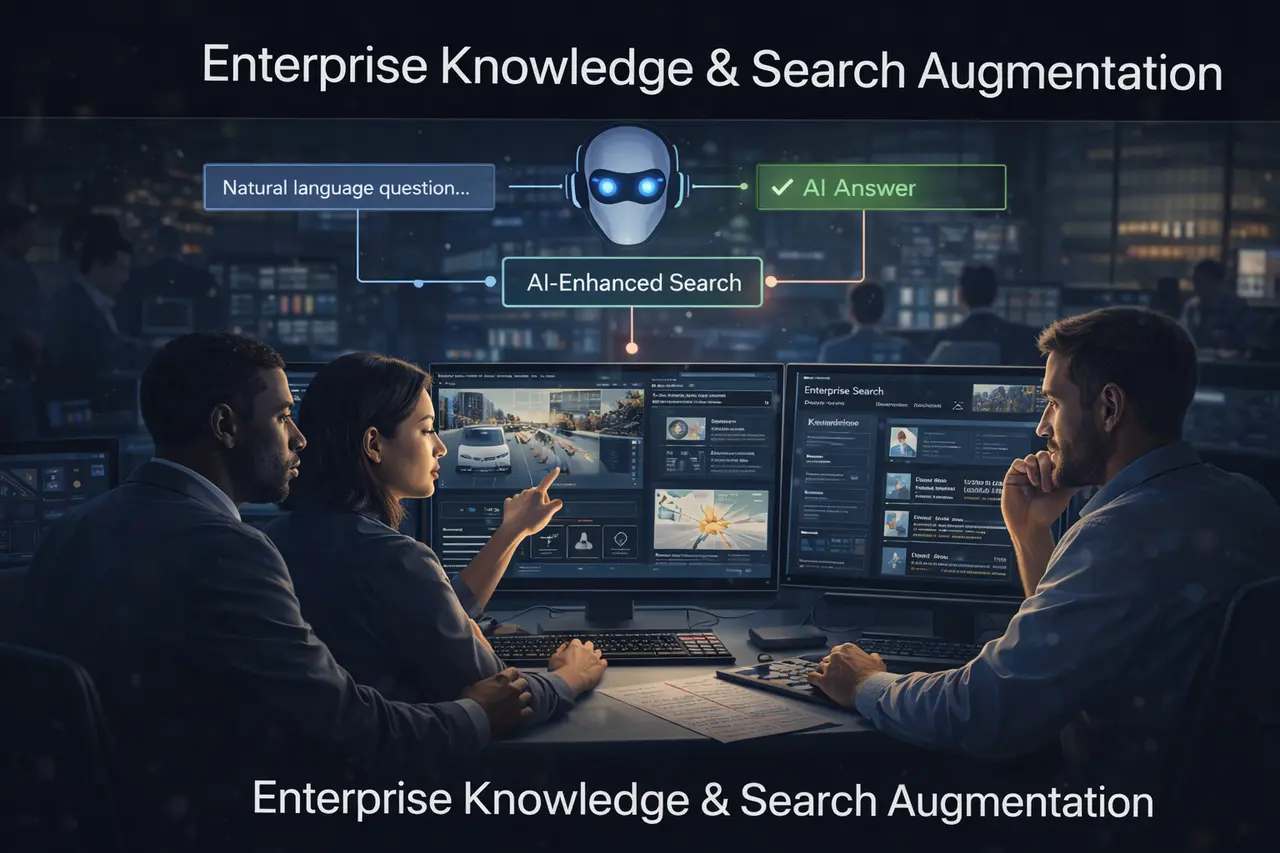
5. Enterprise Knowledge & Search Augmentation
Enterprise Knowledge & Search Augmentation
Use case: AI copilots for enterprise search and knowledge synthesis.
As generative AI competes with traditional search engines, research comparing conversational models with informational search systems shows parity on certain queries, but variability on factual precision.
Enterprise deployments now incorporate:
Human fact-check layers
Domain-specific reviewer scoring
SME validation before publishing outputs
In regulated industries (legal, biotech, finance), companies report that human verification reduces deployment risk by over 30%, according to internal industry benchmarking studies cited in consulting analyses from Gartner.
The key difference between consumer AI and enterprise AI is not intelligence, but governance.
Why humans remain essential
Proprietary data interpretation
Policy compliance
Accountability structures
Why Human-in-the-Loop Will Persist
Across domains, three structural realities ensure humans remain embedded in AI systems:
Accountability cannot be outsourced to algorithms.
Edge cases scale with deployment size.
Regulation increasingly mandates oversight.
The 2024 EU AI Act formalizes human oversight requirements for high-risk AI systems, reinforcing what enterprises already practice operationally.
In summary: Human-in-the-loop workflows are not a temporary bridge to full automation, they are a permanent design principle for high-stakes AI systems.
FAQs: Human-in-the-Loop AI (2026)
1. What is a human-in-the-loop (HITL) workflow?
A HITL workflow integrates human review, correction, or decision-making into automated AI systems to improve reliability and accountability.
2. Does HITL reduce AI efficiency?
It can reduce raw speed, but improves precision and lowers downstream risk. In regulated industries, HITL often reduces total operational cost by preventing costly failures.
3. Which industries rely most on HITL?
Healthcare, finance, autonomous systems, legal tech, and enterprise AI deployments.
4. Is HITL only for error correction?
No. It also supports model training (RLHF), red teaming, auditing, and compliance validation.
5. Will HITL disappear as models improve?
Unlikely. As AI systems grow more capable, the cost of rare failures increases- reinforcing the need for structured human oversight.
Continue Reading (Internal Links)
If you’re interested in AI evaluation, search disruption, and human benchmarking, explore: