3D Annotator vs Manual Labeling: Cost, Speed, and Accuracy
Jessy Abu Khalil,Director of Sales Enablement
As AI systems move into robotics, autonomous driving, AR/VR, and spatial computing, the need for high-quality 3D data annotation has grown rapidly. But with this shift comes a key operational question:
Should teams rely on traditional manual labeling, or adopt modern 3D annotation tools?
In short, manual labeling offers control but struggles to scale, while 3D annotators unlock speed and consistency at scale. The real tradeoff lies in cost, efficiency, and accuracy.
3D Annotator vs Manual Labeling: Cost, Speed, and Accuracy
Cost: Upfront Simplicity vs Scalable Efficiency
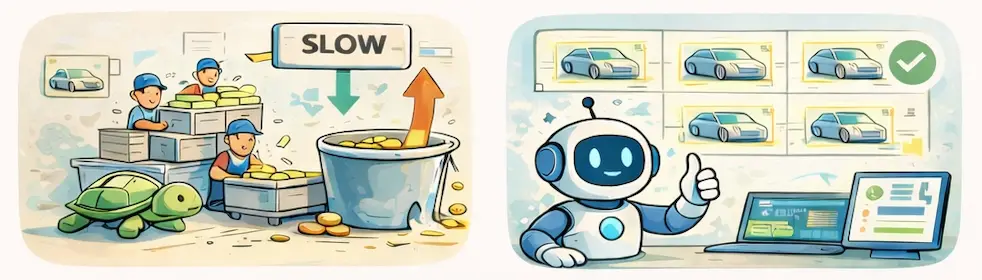
Manual labor costs vs scalable automation efficiency
At first glance, manual labeling appears cheaper. It requires minimal infrastructure and can be deployed quickly with human labor. However, this cost advantage diminishes rapidly as dataset size and complexity increase.
Recent studies show that 3D LiDAR annotation takes approximately 6–10 times longer than 2D image labeling, due to the need to interpret sparse spatial data and maintain consistency across frames. This makes fully manual pipelines expensive at scale.
By contrast, modern 3D annotation systems reduce total cost through automation. Techniques such as interpolation, object tracking, and pre-labeling models significantly reduce repetitive work. Research in label-efficient learning shows that advanced pipelines can reduce annotation effort by 30–60 percent in production settings, with cutting-edge methods achieving even greater reductions.
Summary statement: Manual labeling minimizes upfront cost, but 3D annotators reduce total cost as scale increases.
Speed is where the difference becomes most visible.
Manual labeling scales linearly. Each frame must be labeled independently, which creates a bottleneck as datasets grow. This makes it difficult to support large-scale training or real-time iteration cycles.
3D annotators introduce compounding efficiency. By labeling keyframes and propagating annotations across sequences, they reduce the need for repetitive work. Automated tracking and pre-labeling further accelerate the process.
Empirical studies show that human-in-the-loop 3D annotation pipelines can achieve 3–4× faster labeling speeds compared to fully manual approaches.
In short, manual labeling scales with effort, while 3D annotators scale with efficiency.
Accuracy: Human Judgment vs System Consistency
Human variability vs consistent system-driver labeling
Manual labeling is often associated with higher accuracy because humans can interpret ambiguity and edge cases. However, this comes with variability.
Across large datasets, manual workflows are prone to:
Annotator fatigue
Inconsistent labeling standards
Variability across teams
3D annotation systems improve consistency by enforcing structured workflows and maintaining spatial coherence across frames. Model-assisted pre-labeling can also improve baseline accuracy before human review.
Recent research shows that semi-automated pipelines can achieve comparable or even superior accuracy to manual labeling when combined with human validation.
Summary: Humans excel at edge cases, while systems ensure consistency across scale.
Where Manual Labeling Still Wins
Human expertise is critical for complex edge cases
Despite its limitations, manual labeling remains valuable in specific scenarios.
In early-stage projects or small datasets, manual approaches offer flexibility and control. They are particularly useful for:
Defining new annotation standards
Handling highly ambiguous data
Tasks requiring domain expertise
Manual labeling allows teams to explore and refine their data strategy before scaling.
Where 3D Annotators Dominate
As datasets grow, 3D annotation tools become essential.
They are particularly effective when:
Data includes temporal or spatial dependencies
Consistency across frames is critical
Annotation volume is large
Speed and iteration cycles matter
Industries such as autonomous driving and robotics rely heavily on these systems because manual workflows cannot keep pace with data requirements.
The Hybrid Approach: Human + System
Work smarter not harder
The most effective annotation pipelines today are not purely manual or fully automated. They are hybrid.
Modern systems combine:
Model-assisted pre-labeling
Automated tracking and interpolation
Human validation and correction
Recent work shows that uncertainty-aware systems can direct human effort only where needed, significantly improving efficiency while maintaining high-quality outputs.
The key difference is not human vs machine, but how intelligently they collaborate.
Why This Matters for AI Development
Data quality is one of the most important drivers of model performance. As AI systems become more complex, the way data is labeled becomes a strategic decision rather than an operational one.
Teams that rely solely on manual labeling often struggle to scale. Teams that adopt fully automated systems without human oversight risk losing quality.
The most effective organizations are those that design annotation pipelines, not just labeling tasks, combining tools, workflows, and human expertise.
Summary statement: Annotation is no longer just labeling. It is infrastructure for AI performance.
Key Takeaways
3D data annotation is evolving from a manual task into a system-level capability. While manual labeling offers flexibility and control, it does not scale effectively for modern AI systems. 3D annotators introduce automation, speed, and consistency, making them essential for large-scale data pipelines.
The future lies in hybrid approaches that combine human expertise with system efficiency.
Final summary: Manual labeling builds datasets, but 3D annotators build scalable data infrastructure.
📩 Connect with Abaka AIto explore scalable 3D annotation solutions and see how we can help you build faster, more accurate, and production-ready AI data pipelines.
FAQs
1. What is 3D annotation?
It is the process of labeling spatial data such as LiDAR, point clouds, or multi-view images.
2. Is manual labeling still useful?
Yes, especially for small datasets, edge cases, and tasks requiring human judgment.
3. How much faster are 3D annotators?
They can be 3–4× faster due to automation and interpolation techniques.
4. Are automated systems more accurate?
They improve consistency, and when combined with human review, can match or exceed manual accuracy.
5. What industries rely on 3D annotation?
Autonomous driving, robotics, AR/VR, and spatial computing.