Why Game Data Is Critical for Real-World AI Simulation and Training
Jessy Abu Khalil,Director of Sales Enablement
Game environments are no longer just entertainment systems. In modern artificial intelligence, they have become one of the most powerful tools for training and evaluating real-world systems. From robotics to autonomous driving, game-derived datasets now sit at the core of how agents learn to act, adapt, and generalize. In short, games are no longer just virtual playgrounds. They are controlled, scalable simulations of reality.
Beyond Gameplay: How Game Datasets Power Real-World Simulations
Why Games Are Ideal Data Environments
Game environments naturally encode complexity. They include structured rules, dynamic interactions, and multi-agent systems that closely resemble real-world environments. Unlike traditional datasets, they capture not just static information, but sequences of actions, state transitions, and feedback over time.
This structure aligns closely with reinforcement learning, where agents must learn through interaction. Foundational work such as AlphaGo demonstrated that agents trained through self-play in simulated environments could achieve superhuman performance by optimizing long-term strategies rather than isolated decisions (Silver et al., 2016).
More recent datasets like MineRL extend this idea further. Built on Minecraft, MineRL provides over 60 million state-action pairs, allowing agents to learn complex behaviors in a rich 3D environment (Guss et al., 2019).
Summary: Game datasets provide structured, interactive environments that mirror real-world complexity.
From Games to Real-World Simulation
Training Agents Through Interaction
One of the key advantages of game datasets is that they allow agents to learn through interaction rather than passive observation. This principle has been central to advances in robotics and control systems.
For example, OpenAI’s work on dexterous robotic manipulation showed that agents trained in simulated environments could achieve over 80 percent success rates when transferred to real-world tasks (OpenAI, 2018). This was possible because simulation enabled large-scale exploration that would be infeasible or unsafe in physical environments.
Similarly, simulation platforms such as CARLA provide realistic urban driving environments where autonomous systems can be trained and tested under diverse conditions (Dosovitskiy et al., 2017).
A major challenge in AI is the “reality gap,” the difference between simulated environments and real-world conditions. Game datasets help address this by introducing variability and diversity during training.
Domain randomization, introduced by Tobin et al. (2017), showed that exposing agents to a wide range of simulated conditions significantly improves real-world transfer. By varying textures, lighting, and physics parameters, agents learn to generalize beyond any single environment.
More recent work, such as Robust-Gymnasium (2025), further highlights that many systems still fail under environmental uncertainty, reinforcing the need for diverse and dynamic training environments.
In short, simulation derived from games reduces the gap between training and reality.
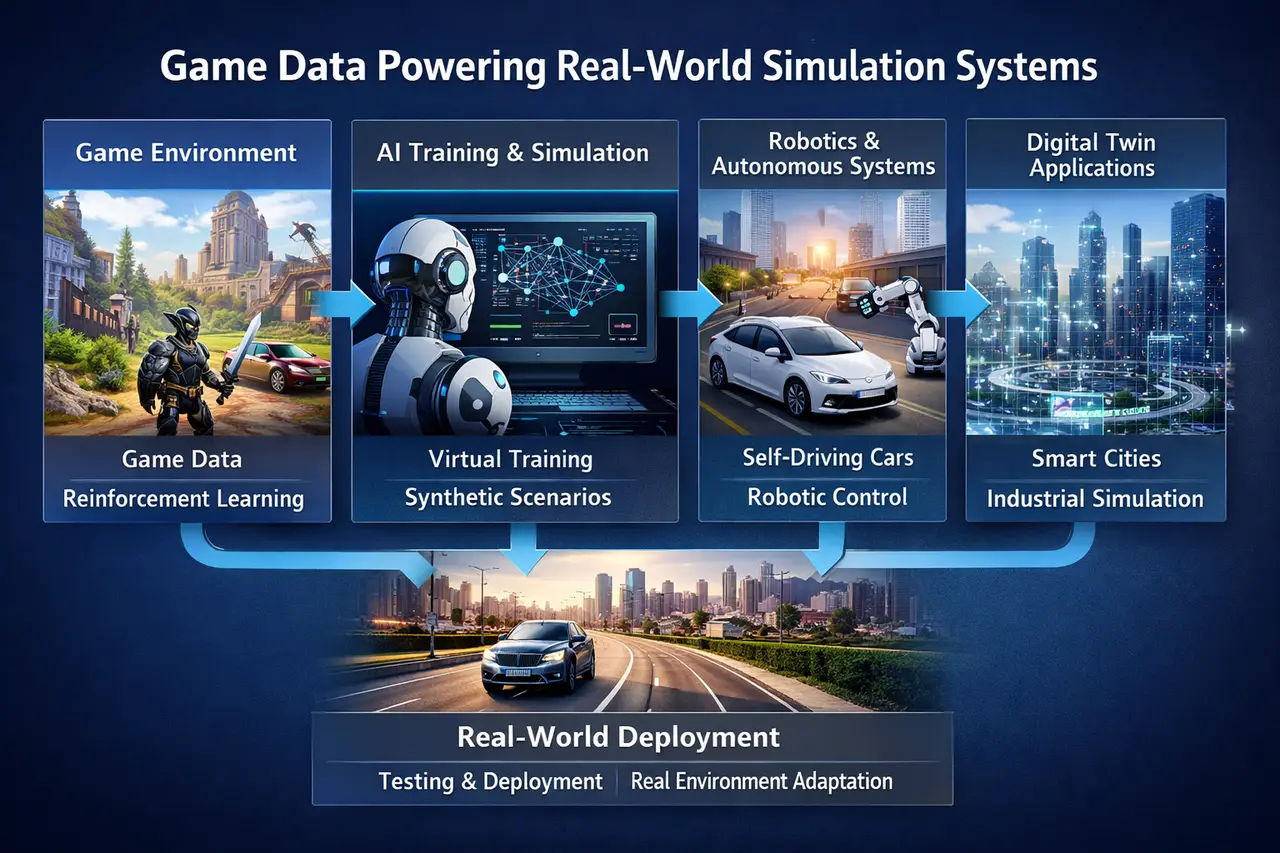
Visualizing the Role of Game Data
Game Data → Real-World Simulation Pipeline
Game data powering real-world simulation systems
Case Studies: Where Game Data Drives Real Impact
The impact of game datasets becomes particularly clear when looking at real-world applications.
In robotics, simulation-based training has enabled systems to learn complex manipulation tasks that would otherwise require extensive physical experimentation. OpenAI’s robotic hand is a well-known example, demonstrating that policies learned in simulation can transfer effectively to real-world environments.
In autonomous driving, simulators like CARLA allow developers to test edge cases such as rare accidents or extreme weather conditions. These scenarios are difficult to capture in real-world datasets but are critical for safety.
In multi-agent systems, game environments provide a natural setting for studying coordination, competition, and strategy. Recent work in reinforcement learning benchmarks shows that agents trained in interactive environments outperform those evaluated solely on static datasets when faced with complex, evolving tasks (Abdulhai et al., 2025).
Key takeaway: Real-world capability emerges from interaction, not static data.
Beyond Synthetic Data: Why Games Are Different
While game datasets are often grouped under synthetic data, they represent a distinct category. Traditional synthetic data is generated to approximate real-world distributions, often without interaction.
Game datasets, however, are generated within interactive systems governed by rules, physics, and often human behavior. This makes them more dynamic and better suited for training agents that must act over time.
The key difference is not realism, but interactivity.
Why This Matters for the Future of AI
The growing reliance on game datasets reflects a broader shift in AI. Models are no longer evaluated solely on their ability to predict outputs. Instead, they are judged on how effectively they act within environments.
The Stanford AI Index Report (2024) highlights this transition, noting that real-world deployment challenges increasingly require robustness, adaptability, and long-term reasoning.
Game environments provide a scalable way to train these capabilities before deployment.
Summary statement: The future of AI will be trained in simulation before it is deployed in reality.
Key Takeaways
Game datasets have evolved into foundational tools for modern AI systems. They provide structured, interactive environments where agents can learn through experience, adapt to change, and generalize to real-world conditions.
By enabling safe, scalable experimentation, these datasets are driving progress in robotics, autonomous systems, and beyond.
Final summary: Games are no longer just virtual worlds. They are training grounds for real-world intelligence.
FAQs
1. What are game datasets in AI?
Game datasets are collections of interactions, actions, and states generated within game environments, used to train and evaluate AI systems.
2. Why are games useful for AI training?
They provide controlled, interactive environments with feedback loops, enabling efficient and scalable learning.
3. How do game datasets help real-world applications?
They simulate complex scenarios, allowing AI systems to learn behaviors that transfer to robotics, driving, and other domains.
4. What is the reality gap?
It is the difference between simulated training environments and real-world conditions, which can impact performance.
5. Are game datasets the same as synthetic data?
No. Game datasets involve interactive systems, making them more suitable for training agents than static synthetic data.
Internal Linking
If you’re interested in simulation-driven AI, agent training, and real-world deployment, explore:
These articles expand on simulation, data strategies, and agent performance, helping you design AI systems that scale reliably in real-world environments.
📩 Contact Abaka AI to move beyond static data and build simulation-driven datasets for real-world AI systems.
Guss, William H., et al. “MineRL: A Large-Scale Dataset of Minecraft Demonstrations.” arXiv, 2019. https://arxiv.org/abs/1907.13440
Dosovitskiy, Alexey, et al. “CARLA: An Open Urban Driving Simulator.” Conference on Robot Learning, 2017. https://arxiv.org/abs/1711.03938
Tobin, Josh, et al. “Domain Randomization for Transferring Deep Neural Networks from Simulation to the Real World.” IROS, 2017. https://arxiv.org/abs/1703.06907
Stanford Institute for Human-Centered Artificial Intelligence. AI Index Report 2024. Stanford University, 2024. https://aiindex.stanford.edu/report/
Abdulhai, Marwan, et al. “LMRL Gym: Benchmarks for Multi-Turn Reinforcement Learning with Language Models.” Proceedings of Machine Learning Research, 2025. https://proceedings.mlr.press/v267/abdulhai25a.html
Zhang, et al. “Robust-Gymnasium: Benchmarking Reinforcement Learning under Environmental Uncertainty.” arXiv, 2025. https://arxiv.org/abs/2502.19652
What's your data bottleneck this quarter?
Missing data
We collect it.
Messy data
We label it.
No time
We have itOff-The-Shelf.
Pick the closest fit, we'll take the call from there.