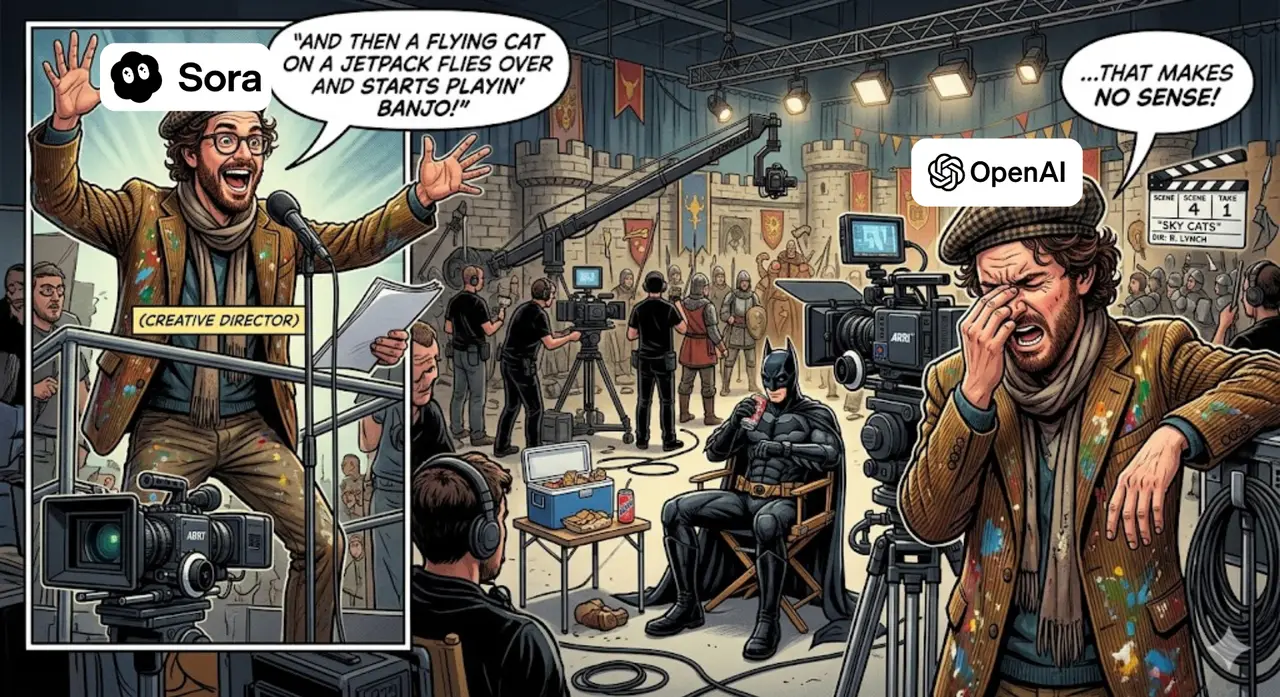
Why OpenAI Sidelined Sora: Prioritizing Logic Over Creative Hype
OpenAI is choosing to build the brain before the eyes. Why?
Why Sora Had to Step Away: OpenAI Is Choosing Core Intelligence Over Creative Hype
What is it about a sunset that makes us want to capture it, even when the camera never gets the colors right? We have this human obsession with the visual, and for a while, OpenAI’s Sora was the ultimate digital sunset. It was the "wow" factor, the creative high, the promise that we could conjure cinema from a single sentence.
Core reasoning intelligence = the new North Star. It turns out, making a cat play the piano in high definition is a luxury, and making an AI that can think through a complex physics problem is a necessity for the survival of the species (or at least of the company).
The Unforgiving Math of Beauty
Let’s be real: Sora was a bit of a diva. While the initial hype was priceless, the operating costs were anything but. By early 2026, reports indicated that Sora was consuming $15 million per day on computing resources. When you’re staring at an annual burn rate of over $5.4 billion for a tool that generated only $2.1 million in lifetime revenue, there comes a time when the accountants eventually stop smiling. Moreover, it became clear that "creative freedom" meant very different things to different people. Between legal headaches involving celebrity likenesses and users trying to "stress test" the boundaries of safety, the model became a PR lightning rod.
In short, Sora was great at generating engagement but failed at generating the kind of revenue that could offset its staggering operational friction. It produced as much legal friction as it made a beautiful video.
While we were all busy marveling at AI-generated waves crashing on digital shores, OpenAI’s internal compass was shifting toward the o-series models (eg, o1 and o3-mini). These aren't "creative" in the traditional sense; they paint by planning.
Ordinary Tuesday in a world of Sora
Logic Over Aesthetics
The decision to sideline Sora was an "Intelligence Gap" as well. Professional creators found Sora’s outputs, while obviously stunning, lacked granular control. You couldn't move a camera path by 5 degrees or keep a character's face consistent across ten clips.
Why?
Because Sora didn't understand physics or spatial logic perfectly, it was just guessing the next pixel. In contrast, OpenAI's o-series models (like o3-mini) use chain-of-thought reasoning to map out complex logic before answering. These models showed a 39% reduction in major errors on difficult real-world questions, proving that the market values a model that can figure out physical operations over one that can merely render them.
OpenAI realized that the path to AGI goes through logic, math, and verifiable reasoning.
Why are we comparing them? The Reasoning Is The New World Simulator
Why are we comparing them? Because OpenAI’s ultimate goal isn't making movies, it's leaning more towards AGI.
For a long time, there was a belief that if you trained AI on enough video, it might implicitly learn the laws of physics, that patterns in motion would eventually turn into understanding.
Sora complicated that idea. It can generate realistic scenes, but it still struggles with basic cause-and-effect and physical consistency. In many cases, it predicts simply what the world looks like.
In that sense, Sora exposed a gap: high-quality visual generation can emerge before true world understanding. The model just approximates physics.
Thus, OpenAI realized that reasoning (o-series) is a more efficient way to build a "World Model." Instead of wasting billions of dollars teaching an AI to draw every individual pixel, they are now teaching it the mathematical law of gravity first.
In short, Sora made an attempt to learn about the world through its eyes. The o-series is an attempt to learn the world through its brain because it's cheaper to run and harder to fool.
Creative VS Reasoning Cpabilities
So What? (Why Reasoning Needs a New Kind of Map)
This change from pretty pixels to hard logic changed the requirements for AI training almost overnight. You can't teach a model to reason by just showing billions of random YouTube videos. You need high-fidelity, verified logic chains. To build Core Intelligence, models require Multimodal RLHF, whichexplains the why behind physical interaction.
The Logic Leap: By utilizing expertly-annotated datasets in technical domains, developers have seen formalization accuracy jump from 54% to 84%.
Accuracy is the New Currency: While standard AI-assisted labeling is fast, it often lacks the nuance required for reasoning. Companies like Abaka AI provide the ground truth for models to move from mimicry to understanding.
Sora’s Shutdown: Officially announced March 2026; driven by a high inference costs, ethics, and a strategic pivot toward World Simulation for robotics.
Reasoning Priority: OpenAI redirected GPU resources to the o-series, prioritizing mathematical and logical planning over video generation.
Data Strategy: Scaling intelligence now depends on high-quality, human-verified logical datasets (can be built by firms like Abaka AI) instead of raw and unorganized video data.
Looking Ahead
OpenAI is choosing to build the brain before the eyes. It might feel less magical for a moment, but it’s the foundation for a world where instead of drowing a bridge AI knows how to build one that won't fall down.
Q1 Why was Sora canceled if the videos looked so good?
A: Beauty is expensive. Sora’s operational costs and the lack of precise frame-by-frame control for professionals made it unsustainable compared to reasoning-focused models.
Q2 What is Core Intelligence?
A: It refers to the AI’s ability to reason, plan, and solve complex problems (like coding or math) with high accuracy, rather than just predicting the next pixel in a video.
Q3 How does data annotation affect AI reasoning?
A: Models learn from examples. High-quality annotation from providers like Abaka AI ensures that the AI is learning logical steps and factual truths, which reduces hallucinations and improves problem-solving.
Q4 Will OpenAI ever release a video tool again?
A: Likely, but it will probably be integrated as a feature within a more intelligent model that understands the physics and logic of the scene