Best Scale AI Alternatives for Enterprises in 2026 | Top 6 Providers
Iskra Kondi,Growth Specialist
In 2026, as AI is evolving, so is the landscape of data labeling and annotation. While Scale AI has been a leading player, new competitors are offering innovative solutions that cater to specific needs of enterprises. In this article, we explore the best Scale AI alternatives, highlighting key factors like cost, customization, and service speed. We also dive into how these platforms are pushing the boundaries of AI data labeling, offering tailored, high-quality services that may better align with your unique business needs.
Best Scale AI Alternatives for Enterprises in 2026
For years, Scale AI has been one of the most recognized names in AI data infrastructure. Its impact was strong enough to define what modern data annotation at scale looks like, from powering autonomous vehicles to supporting large language models. But in the current stage we are now 2026, enterprise needs have evolved.
Despite its strengths, there are some reasons why enterprises are considering alternatives. From cost efficiency to tailored services, new players in the space are offering different perspectives that might suit specific needs more closely (Contrary Research, 2025).
Today, companies are no longer just looking for annotation vendors. They need end-to-end AI data partners that can support complex pipelines, multimodal data, evaluation frameworks, and domain-specific requirements. As a result, many enterprises are actively exploring alternatives to Scale AI that offer more flexibility, specialization, and control.
So what should you look for and which providers stand out?
Key Reasons to Explore Scale AI Alternatives
Undoubtly, Scale AI’s solutions are highly effective for certain domains, they may not be the best fit for every enterprise. Several factors could prompt companies to explore alternatives, including:
Cost Efficiency: Scale AI's pricing can be a significant barrier, with costs starting at $5,000 for basic models and exceeding $500,000 for advanced applications. In comparison, many alternatives offer similar services at a more budget-friendly rate (Labellerr, 2025).
Customization and Flexibility: Alternatives may provide more customized solutions tailored to specific industries, such as medical imaging, NLP, or multimodal datasets. Scale AI's strengths lie primarily in computer vision, making it less ideal for enterprises needing more diverse data types (Twine, 2025).
Service Speed: As Scale AI expands its operations and customer base, its size can make it harder to react quickly to client needs. In contrast, smaller, more specialized platforms often offer faster turnaround times and more flexible support.
Privacy and Security Concerns: For enterprises dealing with sensitive data, taking healthcare or finance as an example, using a third-party service like Scale AI can raise privacy and security concerns. Some alternatives offer specialized services with enhanced security measures and governance (Labellerr, 2025).
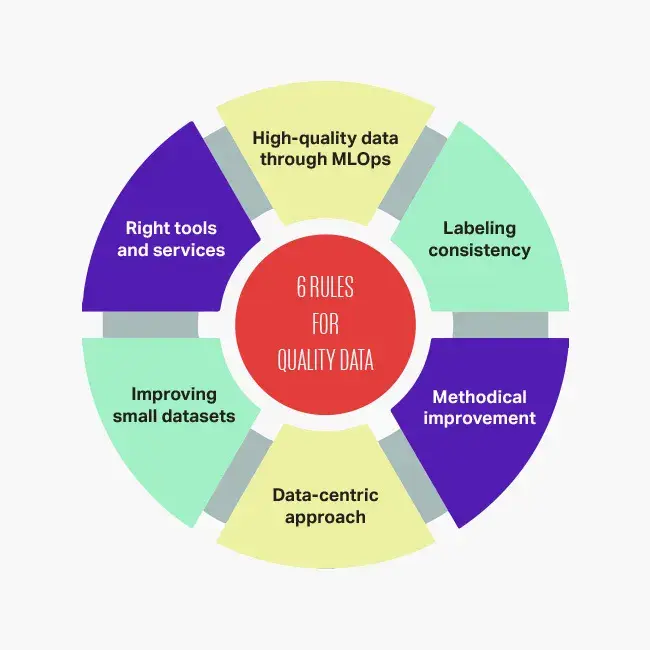
Quality Data: What It Takes (Source: Medium.com).
What to Look for in a Scale AI Alternative
Before jumping into providers, it’s important to define what “better” looks like in 2026:
End-to-end capabilities: data collection, curation, annotation, and evaluation
Domain expertise: robotics, healthcare, finance, manufacturing, etc.
Custom pipeline support: not just annotation, but full workflow design
High-quality human-in-the-loop systems
Scalable infrastructure for multimodal data
Transparent QA and evaluation frameworks
Top Scale AI Alternatives for Enterprises
1. Abaka AI
Abaka AI stands out among alternatives due to its highly specialized focus on tailored data labeling services, particularly in domains such as autonomous driving and generative AI. They have helped companies reduce annotation costs by developing proprietary tools, including a 4D annotation tool for autonomous driving. Additionally, its focus on "chain-of-thought" annotation for generative AI datasets places it at the forefront of AI model training.
If you're looking for a full-stack AI data partner, Abaka AI stands out as a strong alternative.
Unlike traditional annotation vendors, Abaka focuses on end-to-end data operations, including:
Dataset curation for complex AI systems
High-quality annotation pipelines
Model evaluation and benchmarking
Data collection for real-world environments
This makes it particularly well-suited for:
Robotics and embodied AI
Computer-use agents
Enterprise automation systems
What differentiates Abaka is its ability to design data pipelines tailored to specific use cases, rather than forcing companies into predefined workflows.
2. Labelbox
Labelbox has evolved from a labeling tool into a data-centric AI platform.
Strengths:
Strong developer tooling and UI
Good support for multimodal datasets
Flexible integration with ML pipelines
Best for: Teams that want in-house control with a platform-first approach.
3. Snorkel AI
Snorkel takes a different approach by focusing on programmatic data labeling instead of manual annotation.
Strengths:
Weak supervision and labeling functions
Reduced reliance on manual labeling
Strong fit for structured enterprise data
Best for: Organizations looking to automate labeling at scale.
4. Appen
One of the oldest players in the space, Appen offers large-scale human annotation services.
Strengths:
Global workforce
Experience across industries
Scalable labeling operations
Limitations: Less flexibility for cutting-edge AI systems like agents or robotics.
5. Sama
Sama combines annotation services with a strong focus on ethical AI and workforce quality.
Strengths:
High-quality training data
Ethical sourcing and governance
Strong QA processes
Best for: Enterprises prioritizing responsible AI development.
6. Toloka
Toloka offers a crowdsourcing-based data labeling platform with flexible task distribution.
Strengths:
Fast scaling of annotation tasks
Cost-effective labeling
API-first platform
Best for: Teams needing rapid, large-scale data generation.
Alternative
Key Strengths
Best For
Limitations
Abaka AI
End-to-end data pipelines, dataset curation, model evaluation, AI system support
Complex AI systems, robotics, multimodal models
Requires more custom integration for very niche cases
Labelbox
Developer tooling, flexible integrations, good support for multimodal datasets
In-house control, platform-first approach
Less tailored to cutting-edge AI like agents or robotics
Snorkel AI
Weak supervision, programmatic data labeling, reduced manual annotation
Automating labeling at scale
Best suited for structured data, not highly complex workflows
Appen
Large-scale human annotation, experience across industries
Mass-scale annotation for traditional tasks
Less flexibility for cutting-edge use cases like agents
Sama
Ethical AI, high-quality training data, robust QA processes
Enterprises prioritizing responsible AI
May require significant customization for advanced systems
The best Scale AI alternative depends on your needs:
If you want a full-service partner → Abaka AI
If you want a platform to manage internally → Labelbox
If you want automated labeling approaches → Snorkel AI
If you need massive human workforce scaling → Appen or Toloka
If you prioritize ethical sourcing and QA → Sama
The key is to align your choice with your AI maturity and use case complexity.
Final Thoughts
Scale AI helped define the first generation of AI data infrastructure. But in 2026, the demands of enterprise AI have outgrown traditional annotation models.
The future belongs to companies that can:
Build custom data pipelines
Support complex, real-world AI systems
Deliver continuous evaluation and improvement
And that’s exactly where the new generation of providers is stepping in.
If you're moving beyond basic annotation and need a partner that understands complex AI systems, multimodal data, and real-world evaluation, Abaka AI can help.
From dataset curation to model evaluation, we design end-to-end data pipelines tailored to your use case.
👉 Get in touch to explore how Abaka AI can support your next AI initiative.
References:
Contrary Research. (2025). Scale AI Company Overview. Retrieved from Contrary Research
Labellerr. (2025). 6 Best Alternatives for Scale AI. Retrieved from Labellerr
Twine. (2025). Why Look for Scale AI Alternatives?. Retrieved from Twine
FAQ (People Also Ask)
What is Scale AI used for?
Scale AI provides data annotation and labeling services that help train machine learning models, particularly in areas like autonomous driving, natural language processing, and computer vision.
Why are companies looking for Scale AI alternatives?
Enterprises are looking for more flexibility, better transparency, and support for complex AI systems like multimodal models and computer-use agents.
What is the best Scale AI alternative in 2026?
The best alternative depends on your needs. Companies like Abaka AI offer full-service data pipelines, while others like Labelbox and Snorkel AI focus on platforms and automation.
Do enterprises still need data annotation services?
Yes—but annotation is now just one part of a broader pipeline that includes data collection, curation, and model evaluation.
What makes a good AI data partner?
A strong AI data partner provides high-quality datasets, supports custom workflows, ensures robust evaluation, and adapts to evolving model requirements