Top 5 Embodied AI Annotation and Labeling Services in 2026
Alexandra Bezea-Tudor,Marketing Specialist
As the Embodied AI market surges to $23 billion, the success of autonomous agents hinges on moving from generic data to specialized, code-level annotation. This guide ranks the top 5 providers in 2026 that offer the domain focused precision and security required for industrial-grade robotics.
Top 5 Embodied AI Annotation and Labeling Services in 2026
The global embodied AI market is projected to grow from USD 4.44 billion in 2025 to USD 23.06 billion by 2030 (MarketsandMarkets Analysis), driven by rapid progress in humanoid robotics and physical AI systems. High-quality data annotation remains the foundation for success, enabling robots to accurately interpret complex sensor inputs and interact safely with the real world.
Poor data quality is a persistent bottleneck: Gartner estimates it costs organizations an average of $12.9 million annually and contributes to significant AI project setbacks. Multimodal labeling presents unique challenges, such as missing modalities and sensor alignment, which require specialized tools for temporal consistency (Farhadizadeh et al. 2025).
This 2026 ranking is based on scalability, multi-sensor support (LiDAR, RGB-D, tactile), and documented robotics case studies.
The Next Frontier in Robotics and Human Collaboration
Key Robotics Trends Shaping Data Requirements in 2026
Focuses on private, secure sensor stream labeling.
Labor Allies
Collaborative Autonomy
Drives demand for intuitive natural language/vision.
Top 5 Embodied AI Annotation Services in 2026
1. Abaka AI
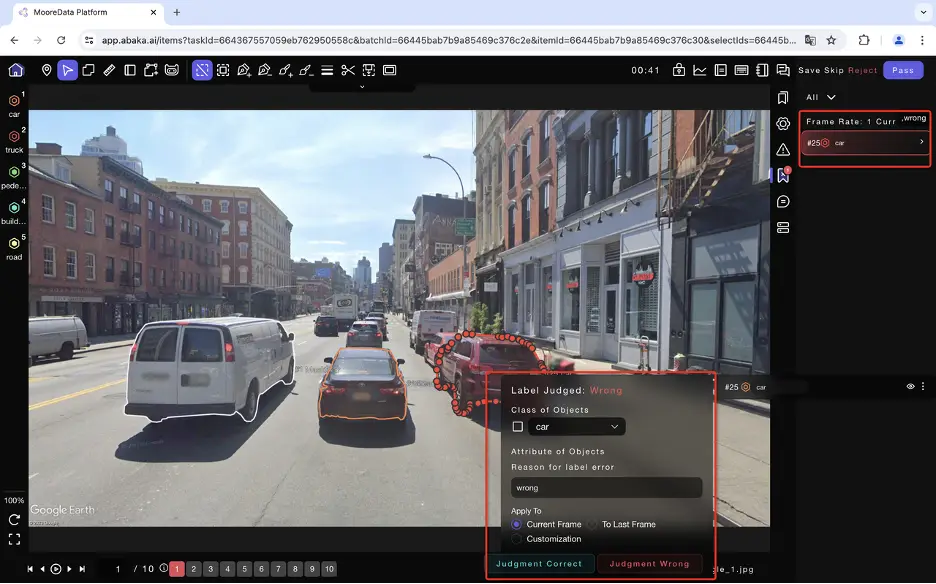
Abaka AI delivers end-to-end data engineering for embodied AI, from collection to high-precision multimodal annotation via its proprietary Abaka Forge platform. Abaka AI supports the full data lifecycle: from collection and cleaning to complex 3D/4D point cloud and ego-centric video labeling
Unified Multimodal Sync: Native support for 3D/4D point clouds, LiDAR, RGB-D, and tactile streams.
All-in-One Abaka Forge Production: Collection, cleaning, annotation, and training in one platform for efficient embodied AI workflows.
Industrial Security: ISO 27001 and 27701 certified ensuring excellence in data quality, security, and privacy.
Global Scale: with 1M+ vertically specialized annotators across 50+ countries, supporting massive, industrial grade data pipelines
Abaka AI Multimodal Annotation Platform
2. Scale AI
Scale AI operates a specialized Data Engine for Physical AI designed to support large-scale robotic deployments through industrial-grade throughput.
Global Collection Network: High-quality, real-world data sourced from a global network of "data factories" and distributed collectors.
High Scalability: Infrastructure engineered to ingest and process massive multimodal datasets from thousands of concurrent collectors.
Data Diversity: Training data collected across varied environments and embodiments, including humanoids and quadrupeds, to ensure model robustness.
3. Encord
Encord is a unified multimodal platform optimized for Physical AI in logistics and industrial automation, focusing on high-speed iteration and visual data curation.
AI-Assisted Video Engine: Features an automated labeling engine that allows robotics teams to process long, continuous sequences up to 6x faster than manual workflows.
Active Learning for Edge Cases: Built-in tools automatically identify and surface "high-value" data, such as rare occlusions or lighting variances to improve model performance.
Documented Results: A 2026 case study with Pickle Robot demonstrated a 15% increase in grasping accuracy and a 60% faster model iteration cycle.
4.Labelbox
Labelbox's Robotics Division (LBRx) provides specialized tools for complex manipulation and agent training.
Synchronized Multi-View Support: Aligns ego-centric, overhead, and wrist-mounted cameras to provide full environmental context for fine-grained manipulation.
Expert Action Trajectories: Captures human demonstrations and precise motion paths optimized for imitation learning and dexterous tasks.
AI Diversity Steering: Automatically identifies dataset "gaps" and redirects collection to ensure robots generalize across diverse materials and cluttered spaces.
5.Sama
Sama offers ethical, high-fidelity annotation with deep experience in sensor fusion for safety-critical systems.
360° Multi-Sensor Fusion: Synchronizes up to 14 sensors, including LiDAR, radar, and thermal, using SLAM algorithms and ego-motion compensation
Dense Spatial Tracking: Specialized in tracking high-density objects and 2D sequences at scale, ensuring consistent identification across complex, high-traffic visual fields.
Long-Sequence Industrial Logic: Combines automation with human expertise to annotate extended workflows, such as multi-minute assembly line footage, with industrial-grade precision
Looking Forward
In 2026, the success of embodied AI relies on data quality more than hardware alone. The shift toward Agentic AI depends entirely on high-fidelity data. As organizations move from experimental pilots to industrial-scale deployments, the demand for multimodal synchronization and domain specific reasoning has become a strategic necessity.
While the market offers several high-quality labeling services, Abaka AI is at the forefront of this shift. By providing the reasoning-ready datasets required for robots to master complex logic, Abaka AI enables enterprise leaders to treat data as a strategic asset rather than a commodity. This ensures the reliable physical agency required for the next generation of automation, delivering a clear path to high ROI in robotics.
Q: Why is high-quality annotation critical for embodied AI?
A: Robots must interpret complex real-world sensors accurately to function safely. Poor data quality drives project failures and costs organizations an average of $12.9 million annually according to Gartner.
Q: What is Agentic AI in robotics?
A: Identified by the IFR as a top trend for 2026, Agentic AI enables robots to combine analytical reasoning with generative adaptability, allowing independent, non-scripted tasks in dynamic environments.
Q: Is embodied AI ready for industrial deployment in 2026?
A: Progress is accelerating, but success depends on high-fidelity datasets that bridge perception and logical reasoning, but widespread industrial deployment depends on high-fidelity datasets that effectively bridge perception and logical reasoning.
What's your data bottleneck this quarter?
Missing data
We collect it.
Messy data
We label it.
No time
We have itOff-The-Shelf.
Pick the closest fit, we'll take the call from there.