Embodied AI systems fail at scale not because models are weak, but because data pipelines cannot sustain semantic consistency, real-time latencies, and governance across multimodal, real-world data.

Embodied AI systems fail at scale not because models are weak, but because data pipelines cannot sustain semantic consistency, real-time latencies, and governance across multimodal, real-world data.

Embodied AI systems, such as robots, autonomous vehicles, and industrial agents operate under constraints that conventional AI systems rarely face. Unlike traditional AI, these systems must learn continuously from multimodal, time-sensitive, and physically grounded data while making decisions in real time and interacting directly with the physical world.
Despite careful considerations and testing, the same failure patterns recur across robotics, healthcare AI, and autonomous driving.
Models perform well during pilot testing but degrade in production
Outputs remain statistically valid but operationally unreliable
Scaling delays even as model architectures improve
In most cases, the root cause of these failures is not the model itself.
It's the data pipeline.
Evidence from enterprise AI deployments and public-sector systems consistently shows that data infrastructure, not algorithms, ultimately determines whether or not AI systems scale reliably.
This focus on data pipelines over model-centric optimization is reflected in how Abaka AI approaches embodied and multimodal AI systems, prioritizing data structure, traceability, and semantic consistency from the start.
Embodied AI systems expose failure modes that static, traditional AI pipelines often mask.
![Comprehensive AI Data Pipeline [1]](https://doxhub.s3.us-east-1.amazonaws.com/abaka/20260116/image-5.webp)
Embodied agents generate heterogeneous data flows that must be processed together:
Vision = video, depth, and point clouds
Language = commands and transcripts
Audio = signals from surrounding environments
Haptics and self-motion awareness
Continuous, high-frequency sensor readings
A comprehensive survey reviewing over 180 studies on embodied AI shows that once systems are outside of controlled settings, scalability is driven primarily by data storage and retrieval architectures rather than by model design (Lu and Tang, 2025).
Diversity and structure matter more than quantity.
Unlike traditional or batch-processed AI systems, embodied AI operates within closed-loop sensing and action cycles. In these systems, increased latency can cause physical failure rather than minor user experience degradation.
As a result, embodied AI pipelines must be able to support:
Sub-100ms data retrieval
Continuous data ingestion
Real-time updates to semantic memory
Many data pipelines designed for analytics or reporting workflows fail silently when these real-time constraints are enforced.
Embodied AI amplifies semantic inconsistencies across data sources. When core concepts such as object, event, state, or interaction are defined differently across systems, models form inconsistent interpretations of the same data. Confidence scores may remain high, but user trust collapses quickly.
This reflects a common enterprise AI failure mode, where data is technically well structured, but the underlying meaning was never explicitly defined or governed. As a result, teams are unable to explain, validate, or defend model decisions.
The key difference between successful pilots and failed deployments is not model accuracy, but shared meaning encoded directly into data infrastructure.
AI data collection entails a lot more than just ingestion. For embodied AI systems, data pipelines must support five continuous stages:
Ingestion = Sensors, APIs, simulation logs, synthetic data
Validation = Schema checks, sensor calibration, anomaly detection
Modeling and Labeling = Semantically aligned annotations that reflect real-world intent
Serving = Low-latency delivery of data and features for inference
Feedback Loops = Drift detection, evaluation signals, and retraining triggers
In production environments, these stages must be enforced systematically rather than informally. Abaka AI operationalizes this pipeline-first approach by structuring data ingestion, validation, semantic labeling, and feedback loops as integrated workflows, ensuring that data remains traceable and semantically aligned across training, evaluation, and deployment.
Failures at any one of these stages can degrade model performance, regardless of architecture. A good rule of thumb to follow is:
If you cannot explain where your data came from, what it means, and how it changed over time, you do not have an AI-ready dataset.
Scaling embodied AI systems is not a linear extension of successful pilots. What is considered successful during pilot testing often breaks once models are exposed to real-world data variability, fragmented ownership, and operational constraints. Pipeline-first designs recognize that accuracy alone is insufficient. Instead, systems must be validated, integrated, operationalized, and scaled in ways that preserve semantic consistency, traceability, and reliability under continuous change.
Proof-of-concept deployments typically succeed under controlled conditions. Datasets are clean, semantic assumptions are informally aligned, and human oversight compensates for gaps in the system. However, this does not reflect conditions during practice.
Once embodied AI systems are exposed to real environments, new domains introduce conflicting definitions, data ownership becomes fragmented, and pipelines lack traceability. Even when a model achieves a high benchmark accuracy, the model can still fail if retraining cannot be repeated reliably. This enforces the need to validate embodied AI systems beyond accuracy metrics.
Integration is where theoretical performance meets operational reality. At this stage, models must connect to real workflows, outputs must trigger downstream actions, and systems must tolerate noisy, incomplete, or delayed inputs.
For embodied AI, this is often where projects halt. Pipelines that perform well in isolation struggle once they are required to interact with production systems and live operational constraints. Without robust integration layers, even high-performing models remain confined to experimentation.
Data pipelines must be treated as long-term infrastructure rather than project-specific tooling. Pipelines must be modular, observable and governed at scale.
This is why large-scale AI systems increasingly adopt two-tier data architectures. Fast, low-latency storage supports active workloads and real-time decision-making, while object storage provides governed, auditable long-term memory for training, evaluation, and compliance.
Operationalization ensures that pipelines remain reliable at scale, as data volumes grow, domains evolve, and system complexity increases.
When embodied AI systems begin to scale broadly, new failure modes emerge. Manual retraining processes break down, inconsistencies accumulate across data sources, and user trust diminishes before performance metrics visibly decline.
Organizations that scale successfully treat AI as an operational product rather than a one-time model deployment. They automate retraining triggers, enforce continuous data validation, and rely on versioned deployment with controlled fallback mechanisms.
This is whyAbaka AI focuses on evaluation-driven data workflows, where retraining triggers, validation checks, and versioned deployments are automated at the data level rather than addressed through repeated model redesign.
At this stage, it becomes clear that AI at scale is fundamentally an operations problem, and no longer a modeling one.
No single database architecture can satisfy all the requirements of an embodied AI system. These systems must simultaneously support real-time perception, long-term memory, semantic reasoning, and large-scale data retention. As a result, storage choices always involve trade-offs between latency, expressiveness, scalability, and consistency.
In practice, successful embodied AI systems rely on combinations of complementary storage architectures, each contributing distinctly to the overall data pipeline.
Architecture | Strength | Limitation |
|---|---|---|
Graph Databases | Causal and relational reasoning across entities | Difficult to maintain consistency under real-time updates |
Vector Databases | Semantic similarity and multimodal retrieval | Susceptible to index drift as environments change |
Time-Series Databases | High-throughput sensor stream ingestion | Limited support for cross-modal fusion |
Data Lakes | Large-scale raw data retention and reprocessing | High access latency, unsuitable for real-time use |
Multi-Model Databases | Unified access across multiple data models | Scheduling and performance complexity under mixed workloads |
Graph databases excel at representing relationships and causal structure, which is critical for reasoning and planning, but struggle under continuous, low-latency update requirements. Vector databases enable semantic matching across modalities, yet their indexes can become misaligned when real-world data distributions shift. Time-series databases are well suited for ingesting continuous sensor streams, but they offer limited support for integrating non-temporal modalities such as vision or language.
Data lakes, on the other hand, play a different role. They act as large-scale repositories that retain raw, unstructured data for future training, auditing, and reprocessing, but their access patterns are too slow for real-time decision-making. Multi-model databases attempt to combine multiple data representations within a single system, reducing integration overhead, though this often comes at the cost of increased scheduling complexity and unpredictable performance.
The key takeaway is that storage architecture is not a choice between alternatives, but about how different systems are combined. Embodied AI systems scale effectively only when these components are integrated deliberately within a pipeline-first design.
Synthetic data is often used to fill rare edge cases, reduce privacy exposure, and accelerate dataset coverage. In embodied AI systems, it can be especially useful for simulating unsafe, costly, or infrequent scenarios.
However, studies have shown that over-reliance on synthetic data has negative impacts on model performance. For example, a study by Lu and Tang (2025) shows that over-reliance can amplify distribution mismatch and degrade real-world performance when not governed by real data feedback loops.
While synthetic data improves coverage, it does not correct weak data pipelines. Without proper validation, traceability, and continuous grounding in real-world data, synthetic datasets can create a false sense of robustness.
Best Practice:
Use synthetic data to target gaps, not replace reality, and always, always validate performance against real-world thresholds.
In embodied AI systems, data modeling plays a critical role in determining whether models behave reliably in real-world environments. Unlike humans, AI systems do not understand intent. They infer meaning from statistical patterns in data. When conceptual and logical data models are missing or poorly defined, models learn from storage artifacts rather than real-world structure.
This often leads to a subtle but dangerous failure mode. Model outputs appear reasonable and confidence scores remain high, but decisions do not align with how the system is expected to operate in practice. Over time, trust declines without a clear signal that something is wrong.
This is why data modeling must be treated as living metadata infrastructure, not as static diagrams created during early system design. Abaka AI applies this principle by embedding semantic definitions, annotation guidelines, and versioned metadata directly into its data workflows, allowing models and teams to share a consistent understanding of objects, events, and interactions as systems evolve.
In embodied AI, data models need to evolve continuously to reflect changing environments, new data sources, and updated system behavior. Strong data modeling ensures that meaning, relationships, and constraints remain explicit and enforceable across the data pipeline.
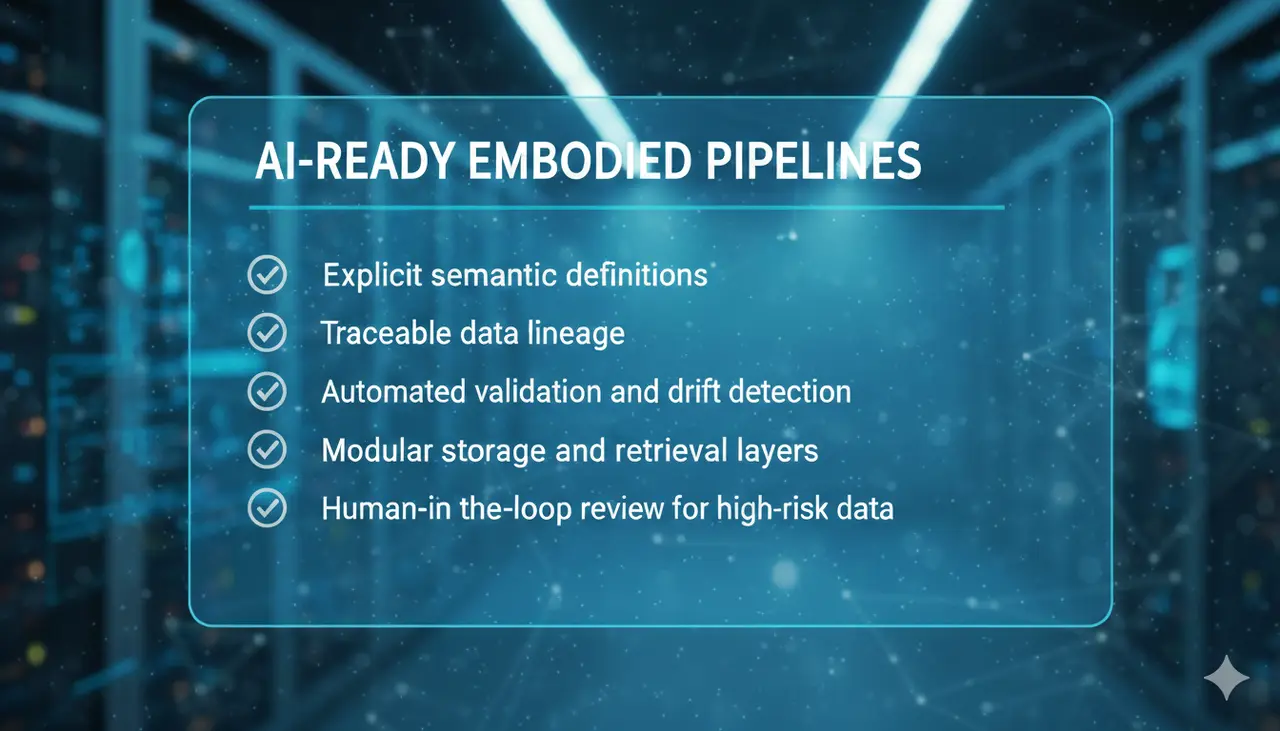
The goal here is not faster pipelines, but defensible, explainable, and repeatable ones.
Embodied AI systems scale with robust data pipelines, not larger or more complex models
Semantic consistency across data sources matters more than raw model accuracy
Latency, reliability, and governance are fundamental data infrastructure problems
Synthetic data complements, but never replaces, real world data
Data modeling functions as operational infrastructure, not documentation
Embodied AI models fail in production when data pipelines cannot maintain semantic consistency, low-latency access, and governance across multimodal data streams. These issues often surface only after deployment, when systems are exposed to real-world variability and fragmented data sources.
No. Evidence across embodied AI research shows model architectures tend to converge in capability. Once this happens, data pipelines become the main differentiator in system reliability, scalability, and long-term performance.
Diversity matters more than volume once minimum coverage is reached. Adding more data of the same type often yields diminishing returns, while expanding environmental variety and edge-case coverage improves generalization.
Synthetic data is useful for targeting rare, unsafe, or costly scenarios, as well as to reduce privacy exposure. However, it must be governed by real-world data feedback loops and validated against real deployment conditions. Synthetic data complements real data but cannot replace it.
Because outputs often remain statistically plausible even when underlying semantics are wrong. Users lose confidence gradually as decisions become harder to explain or justify, long before metrics clearly signal system failure.
ContactAbaka AI - Learn how evaluation-driven data pipelines are built for embodied and multimodal AI systems.
Explore Our Blog - Read articles on multimodal data pipelines, synthetic data limitations, and dataset governance for production AI.
Follow Our News - Get the latest updates from Abaka AI on multimodal data pipelines, embodied AI research, and real-world lessons from production systems.
Read Our FAQs - Get practical answers on data sourcing, labeling workflows, governance, traceability, and scaling AI datasets responsibly.
Sources
Image Source
[1]CDO Times

Missing data

We collect it.

Messy data
We label it.

No time
We have itOff-The-Shelf.
Pick the closest fit, we'll take the call from there.
Missing data
We collect it.
Messy data
We label it.
No time
We have it Off-The-Shelf.
Pick the closest fit, we'll take the call from there.