High-quality data annotation may not make it into robot movies, but it’s the unseen force powering accurate, reliable robotics systems that navigate the real world.

High-quality data annotation may not make it into robot movies, but it’s the unseen force powering accurate, reliable robotics systems that navigate the real world.
Robots have haunted humanity for far longer than we think. Who wouldn't want a metallic friend, a strong, never-tired field worker, an intelligent equal? This idea goes back so far that, in the faraway lands of Ancient Greece, we see Aristotle speculating in his Politics about automata—self-moving machines or objects that could move without human intervention—and how they could someday bring about human equality by making the abolition of slavery possible: “There is only one condition in which we can imagine managers not needing subordinates, and masters not needing slaves. This condition would be that each instrument could do its own work, at the word of command or by intelligent anticipation, like the statues of Daedalus or the tripods made by Hephaestus…” But if something can do what would take us far longer to accomplish, and it's made by our hands, are we now gods, or is it them? Ahem, getting off track here. Yet, when countless movies show a scientist building a robotic entity, we never see them doing the not-so-exciting, yet core, process of annotation.
Robotics data annotation involves labeling data to help robots interpret their environment, a task that is distinct from other fields due to its complexity. Unlike simpler data types such as text or images, robotic systems often rely on high-precision data types like depth perception, motion tracking, and semantic labeling. For example, in autonomous driving, high-quality data annotation is essential for robots to understand and navigate complex environments safely. Liu et al. (2024) point out that the quality of datasets is directly related to fostering user trust in autonomous vehicles.
Moreover, inaccurate or inconsistent data can lead to faulty models that produce incorrect results, just as was demonstrated by a Harvard Business School study, where AI-generated work schedules for large retail chains were compromised by poor data inputs, leading to faulty employee schedules (Rand, 2025). This serves as a reminder that even slight errors in robotic data annotation can have significant, sometimes catastrophic, effects. Annotating robotics data requires specific expertise and tools due to the intricate nature of the data. For instance, understanding 3D environments or tracking keypoints in a moving object requires specialized skills. As robotics is present across industries, annotation standards vary significantly, making scalability a challenge.
In robotics, vision annotation is critical for training robots to recognize objects in real-time. Object detection often relies on bounding boxes or segmentation, especially for tasks like navigation or grasping. As Medium explains, "The robotics data labeling market is becoming a high-stakes, high-growth sector poised for major expansion, driven by the increasing need for high-quality data" (ZippyChain, 2025). The more precise the annotations in these systems, the better robots can interact with their surroundings.
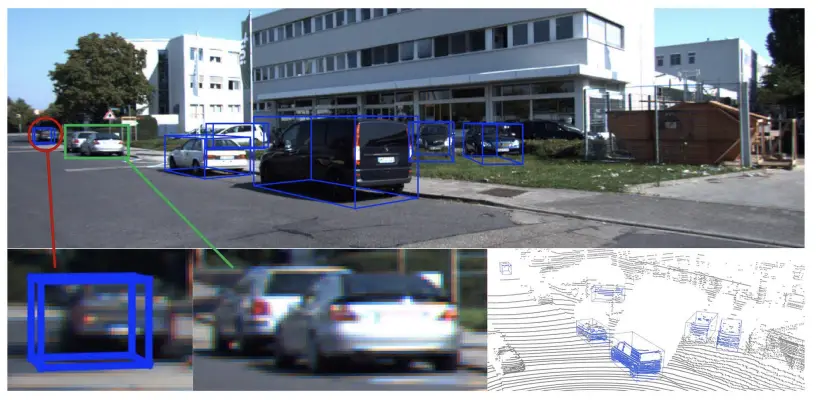
Point clouds are key for depth perception in robots. Annotations of point clouds provide spatial information necessary for tasks like obstacle avoidance. Without accurate annotation, robots may misinterpret distances, leading to safety risks. Due to the complexity of such an endeavor, a more sophisticated framework is needed to ensure the accuracy of labeling high-quality 3D annotations (Liu et al, 2024).
Keypoint and pose annotations allow robots to understand human gestures or object positions. The effectiveness of these annotations directly impacts the robot’s ability to interact with dynamic environments. Crespo et al. (2020) discuss the challenge of semantic labeling in cognitive robots, noting that accurate annotations help robots understand environments in terms of rooms, corridors, and other relevant categories.
Scaling data annotation in robotics is not without its challenges. One major hurdle is maintaining annotation consistency across large datasets. As highlighted by Walsh (2025) when data is mislabelled or inconsistently tagged, AI models learn incorrect patterns, which can later lead to dramatic failures. This is especially true for autonomous driving systems, where misannotated data can compromise safety and lead to errors in real-world scenarios.
Additionally, the need for accurate and consistent annotations across vast amounts of data further complicates scaling. Harvard Business School's research on AI-generated work schedules shows that even small data discrepancies can lead to large errors when systems scale (Rand, 2025).
Establishing clear guidelines and standards helps maintain annotation consistency, especially in high-precision tasks like depth or pose estimation. Regular training sessions for annotators are also essential. If we have it established that a particular type of vehicle is labeled as a car, all instances where this vehicle appears should have it consistently annotated as a car. Annotation precision is another core issue, which refers to whether the labels match the actual state of the objects or scenarios. Correctness, on the other hand, emphasizes that annotated data are pertinent and suitable for the dataset's objectives and annotation criteria (Liu et al., 2024). One way to prevent this is through regular validation of annotations, a practice that helps avoid the propagation of errors across datasets.
Regular audits help identify and address potential inconsistencies early, ensuring a high-quality dataset. Furthermore, using both manual and semi-automatic methods can improve accuracy, as noted in studies by Liu et al. (2024), which recommend a combination of tools to help label 2D/3D bounding boxes and segmentation data more efficiently.
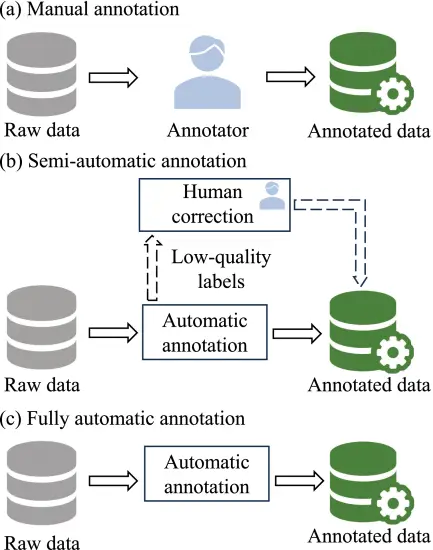
When it comes to choosing between in-house or outsourced annotation teams, quality control becomes a key consideration. While in-house teams offer more direct control over annotation quality, they also require more time and resources. “Costly AI rework” due to poor annotation quality is one of the main reasons some teams prefer in-house data labeling (Walsh, 2025). However, outsourcing can help scale data annotation tasks quickly, provided there is a clear set of guidelines to ensure quality.
In-House Annotation Teams While in-house teams provide greater control and consistency, they require significant investments in training, tools, and infrastructure. Pro: Greater customization and control over data quality. Con: High operational costs.
Outsourced Annotation Teams Outsourcing can be cost-effective and scalable but might come with challenges related to quality control and communication. Pro: Can handle large volumes quickly, lower costs. Con: Risk of quality inconsistency and potential delays.
In short, robotics data annotation plays a crucial role in training systems in the robotics field, but it faces significant challenges in maintaining high-quality, consistent data at scale. Whether in-house or outsourced, organizations must adhere to best practices to avoid the costly pitfalls of poorly labeled data, which can undermine AI performance (Walsh, 2025). Standardizing processes, training annotators, and using advanced tools can help ensure data quality and consistency, leading to enhanced and more effective robotic systems.
Interested in improving the quality and scalability of your data annotation projects? At Abaka AI, we provide high-quality, curated datasets, expert data annotation services, and comprehensive model evaluation solutions.Learn how our services can enhance your machine learning projects.
FAQs:
What is robotics data annotation? Robotics data annotation is the process of labeling data for robotic systems to help them interpret their environment and make decisions.
What are the challenges in scaling robotics data annotation? Key challenges include managing large volumes of data, ensuring consistency across teams, and dealing with complex sensor data.
What are the best practices for maintaining annotation quality in robotics? Standardizing processes, using quality control mechanisms, and conducting regular audits are essential best practices.
Is it better to use in-house or outsourced teams for robotics data annotation? It depends on the scale and budget; in-house teams provide more control, while outsourced teams can handle large volumes at lower costs.
How does point cloud annotation work in robotics? Point cloud annotation labels 3D data captured by sensors, helping robots understand depth and navigate their environment.
References
Crespo, J., Castillo, J. C., Mozos, O. M., & Barber, R. (2020). Semantic information for robot navigation: A survey. Applied Sciences, 10(2), 497.
Liu, M., Yurtsever, E., Fossaert, J., Zhou, X., Zimmer, W., Cui, Y., ... & Knoll, A. C. (2024). A survey on autonomous driving datasets: Statistics, annotation quality, and a future outlook. IEEE Transactions on Intelligent Vehicles.
Rand, B. (2025). Bad Data, Bad Results: When AI Struggles to Create Staff Schedules. Harvard Business School. https://www.library.hbs.edu/working-knowledge/bad-data-bad-results-when-ai-struggles-to-create-staff-schedules
ZippyChain. (2025). Inside the Multi‑Billion‑Dollar Robotics Data Labeling Market. Medium.https://medium.com/@ZippyChain/inside-the-multi-billion-dollar-robotics-data-labeling-market-b67d35ac3746
Walsh, B. (2025). How Poor Data Annotation Leads to AI Model Failures | IoT For All. IoT for All. https://www.iotforall.com/data-annotation-ai-failures
Explore Our Robotics Datasets
Discover the Power of Quality Annotation Services
Contact Us for a Custom Annotation Solution
Learn More About Robotics in Industry [Link to Related Article]
Further Reading
How AI Data Collection Works: Methods, Challenges, and Best Practices
Best data annotation tools for machine learning in 2025
Annotate a Video Poorly and No Amount of Data Will Save Your Mode

Missing data

We collect it.

Messy data
We label it.

No time
We have itOff-The-Shelf.
Pick the closest fit, we'll take the call from there.
Missing data
We collect it.
Messy data
We label it.
No time
We have it Off-The-Shelf.
Pick the closest fit, we'll take the call from there.