Not catastrophic. Not reassuring either. Just revealing.
Not catastrophic. Not reassuring either. Just revealing.
Here’s an irony: the company building one of the world’s most capable AI systems just published research designed to track how much damage that AI system might do to the job market. That’s a bit like a chef writing a report on how their cooking is affecting your waistline. Admirable, really. And also a little alarming.
In early March 2026, economists Maxim Massenkoff and Peter McCrory released "Labor Market Impacts of AI: A New Measure and Early Evidence," a paper that uses real data from Claude interactions in professional settings to map what AI is already doing vs what it’s technically capable of doing. The gap between those two numbers is...interesting.
Previous attempts to forecast AI’s labor market impact had a problem: they were essentially educated guesses. Researchers would list what AI could do, overlay that with job task databases, and publish a loud headline. The report took an entirely different approach.
Their new metric, “observed exposure,” combines theoretical AI capability with real-world usage data pulled directly from how Claude is being used in actual workplaces. The report introduces this metric as an attempt to measure the gap between what AI systems could technically do and what they are doing in workplaces today (EdTech).
All of it resulted in great contrast. Computer and Math occupations have 94% theoretical AI coverage but only 33% real observed coverage. Office and Admin shows 90% theoretical and only 25% observed. Business and Financial sits at 85% theoretical, 20% actual (The AI Corne)
In short, AI is capable of far more than it’s currently doing. The difference between “AI could replace this job” and “AI is replacing this job” is pretty big for now.
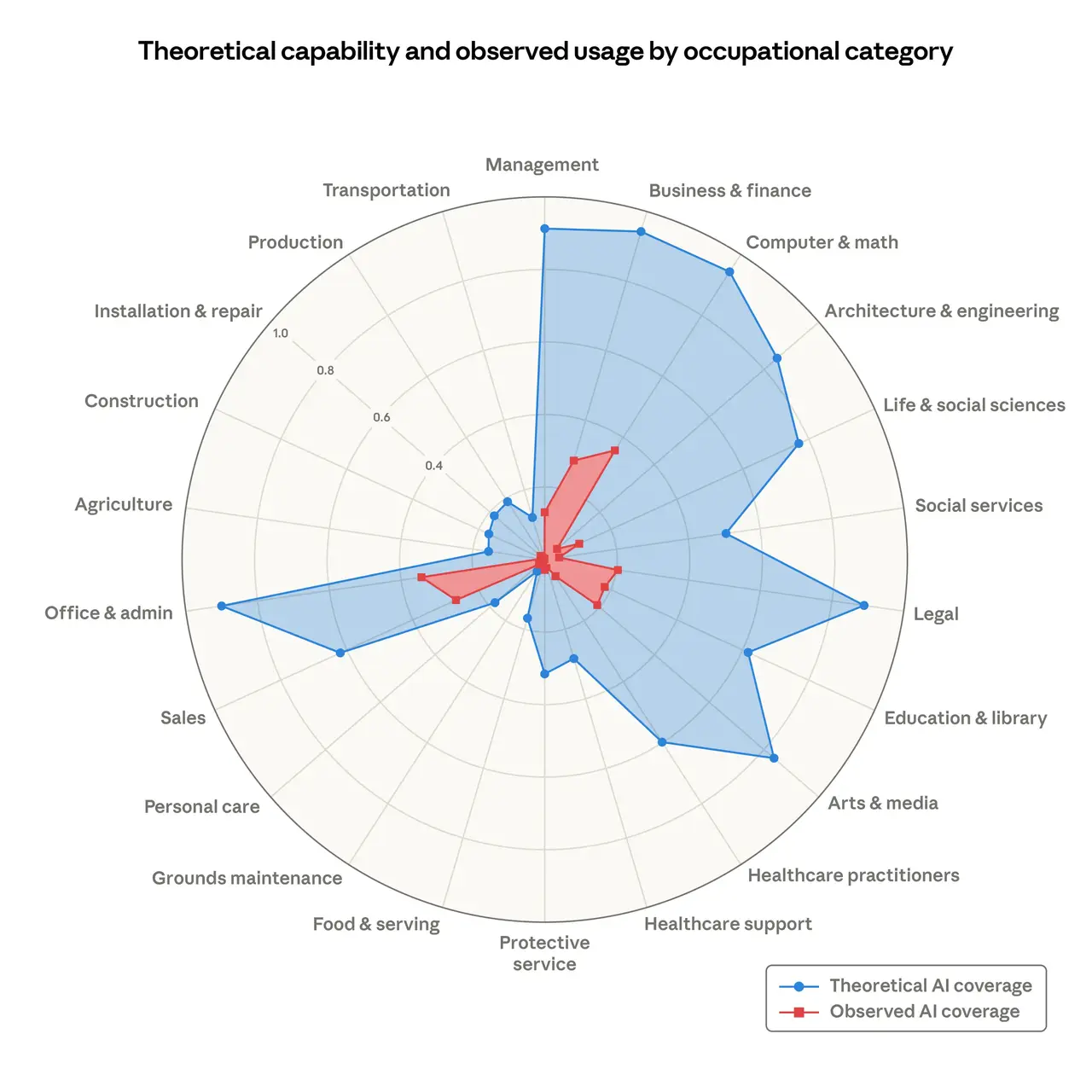
To determine a job’s exposure, authors compared AI’s ability to perform specific tasks with how common those tasks are across professions.
A teacher, for example, AI can grade homework, but it can’t manage a classroom of actual children. (Anyone who’s tried knows...no LLM has mastered this skill). Computer programmers top the list at 75% task coverage by AI. Customer service reps, data entry keyers, and medical record specialists follow closely.
However, here’s the twist: the most at-risk group earns 47% more on average than workers with no AI exposure. They are more likely to be female, more likely to hold a graduate degree, and more likely to be Asian or white. People with graduate qualifications make up just 4.5% of the unexposed group but 17.4% of the most exposed group, a huge difference as well to the contrasting common belief that AI will first take over low-paid jobs (IBTimes).
So if you got educated and landed a well-paying professional job — congratulations! You’re in the front row for disruption. Time to become a lifeguard. Roughly 30% of occupations don’t clear the minimum threshold to register as “exposed,” fields you might expect to be the least susceptible, given how human-intensive they are: cooks, lifeguards, and the like.
The irony practically writes itself.
There is the nuance that separates this research from doomsday newsletters: despite growing debate about AI-driven job displacement, the study finds no clear evidence that AI has increased unemployment so far.
But, and this is a meaningful but, the report does find “suggestive evidence that hiring of younger workers,” particularly ages 22 to 25, “has slowed in exposed occupations.”
A parallel 2025 study by Brynjolfsson, Chandar, and Chen using ADP payroll data found a 16% fall in employment in jobs exposed to AI among workers aged 22 to 25 (Brynjolfsson et al.).
The door isn’t closing, but fewer people are being let in.
For every 10 percentage point increase in observed AI coverage, the BLS’s projected employment growth for that occupation drops by 0.6 percentage points.
In short, AI job loss isn’t showing up as mass unemployment yet, but it is showing up as slower hiring of young workers in exposed fields.

The paper doesn’t shy away from naming the nightmare scenario: something resembling a white-collar version of the 2008 financial crisis. Back then, U.S. Unemployment doubled from 5% to 10% in under two years. The researchers point out that a similar doubling in the most AI-exposed occupations (from 3% to 6%) would register clearly in their model. So far, it hasn’t.
That said, there are projections that AI could eliminate up to half of the entry-level professional jobs and push unemployment into the 10–20% range, potentially within the next five years. Mustafa Suleyman, Microsoft’s AI chief, went even further, suggesting the bulk of professional work could be automated within 18 months.
The researchers pump the brakes slightly. The current gap between what AI can do and what it’s replacing is real, kept in place by regulatory friction, software integration challenges, model imperfections, and the ongoing need for human oversight. But they’re clear: these are delays, not permanent shields.
There’s something philosophically interesting: a company whose revenue depends on AI adoption is publishing an early warning system for AI-driven unemployment. As economists write: “By laying this groundwork now, before meaningful effects have emerged, we hope future findings will more reliably identify economic disruption than post-hoc analyses.”
Amodei says he hopes the index spurs other companies to share insights on how workers are using their models, giving policymakers a more comprehensive picture.
In other words, someone has to sound the alarm early. Might as well be the ones who built it.
Q: What is “observed exposure” and why does it matter?
It’s a new metric combining what AI can theoretically do with what it’s actually doing in real workplaces, based on usage data. It matters because past predictions of AI disruption relied purely on theoretical capability, which consistently overstated real-world impact. Observed exposure gives a more grounded, honest picture.
Q: Which jobs are currently most exposed to AI?
Computer programmers (75% task coverage), customer service representatives, data entry keyers, and medical record specialists top the list. Notably, the most exposed workers tend to be higher-paid, more educated, and more likely to be female, counterintuitive but consistent with how AI targets structured cognitive tasks rather than physical ones.
Q: Which jobs are most exposed to AI? Research shows the highest AI exposure in computer programming, customer service, and data entry roles, where AI can perform a large portion of daily tasks. In some cases, AI coverage of tasks in these occupations reaches roughly 67–75%, making them among the most affected fields.
Q: What jobs have been displaced by AI? Large-scale job displacement from AI has not yet been widely observed; most studies show that AI is currently augmenting tasks rather than replacing entire occupations. Labor market analyses indicate stable employment overall, though some early hiring declines have appeared in AI-exposed entry-level roles like clerical work and software development.
Q: Which jobs can be affected by AI? Many knowledge-based professions can be affected by AI, especially those involving writing, coding, data analysis, and administrative tasks. Studies estimate that about 36% of occupations already use AI for at least a quarter of their tasks, indicating broad but uneven exposure across the workforce.
Q: What jobs will not be displaced by AI? Jobs that rely heavily on physical work, unpredictable environments, or human interaction, such as electricians, mechanics, healthcare workers, and many skilled trades, are considered less vulnerable to automation. These roles depend on real-world judgment and manual skills that current AI systems struggle to replicate.
Q: Is AI already causing job losses?
Not in measurable unemployment figures. But hiring of workers aged 22–25 has slowed in highly exposed occupations, and a separate 2025 study found a 16% employment drop for young workers in AI-exposed roles. The damage is in hiring freezes rather than layoffs.
Q: Why does an AI company publish research about AI job loss?
Partly responsibility, partly strategic foresight. A warned about a potential “white-collar bloodbath” and the necessity of building measurement tools before the disruption becomes undeniable, so policymakers and businesses can respond before the crisis.
👉Human-in-the-Loop Examples: 5 Real AI Workflows That Still Need Humans in 2026
👉What Is Human-in-the-Loop AI? How It Works, Examples, and When Humans Still Matter in 2026
👉Sigil Wen’s Automaton: How an AI Agent Earned $10,000 in 7 Hours

Missing data

We collect it.

Messy data
We label it.

No time
We have itOff-The-Shelf.
Pick the closest fit, we'll take the call from there.
Missing data
We collect it.
Messy data
We label it.
No time
We have it Off-The-Shelf.
Pick the closest fit, we'll take the call from there.