ChatGPT Image vs Nano Banana Pro: Capabilities, Trade-offs, and Creative Use Cases
Tatiana Zalikina,Director of Growth Marketing
From conversational storytelling to studio-grade visual engineering, this article breaks down ChatGPT Image and Nano Banana Pro's real capabilities, real limits, and the use cases where each of them steals the spotlight
Comparing ChatGPT Image and Nano Banana Pro. Capabilities, Limits, and Use Cases (2025). Which Paintbrush Paints Better?
Two AI artists walk into a bar...oh, sorry, wrong draft.
What happens when two AI artists walk into a virtual studio? One speaks in conversational fluency, “Make this cozy café scene unique”, while the other listens, waits, then paints like an avant-garde photographer who alsoknows physics. That’s the story of 2025, with ChatGPT Image and Nano Banana Pro, two generative systems that, at first glance, both turn text into visuals, yet underneath, their engines hum different rhythms.
Here’s your backstage pass: the real capabilities, the real limitations, and how each tool finds its stage in the creative world.
Act I: What They Are, Two Generators, Two Philosophies
ChatGPT Image (powered by GPT Image 1.5) is conversation-first image generation, a model that builds visuals out of natural language prompts within the ChatGPT ecosystem (web and API). It’s designed to understand intent, context, and even edit images based on instructions you feed it through a chat interface. Today’s version is notably faster and more precise than the pre-2025 image models, delivering up to 4× faster generation and stronger adherence to prompts while preserving composition, lighting, and fine details.
Nano Banana Pro, on the other hand, is Google’s Gemini 3 Pro Image powerhouse, part of the Gemini suite, aimed at studio-grade AI visuals. It’s built to generate high-fidelity images in 2K–4K resolution, maintain brand or character consistency, and render clear text and advanced compositional controls like lighting and camera angle.
Let's say ChatGPT Image is the eloquent storyteller with a paintbrush, while Nano Banana Pro is the cinematographer who also knows how to stage lighting, set angles, and weave world knowledge into the scene.
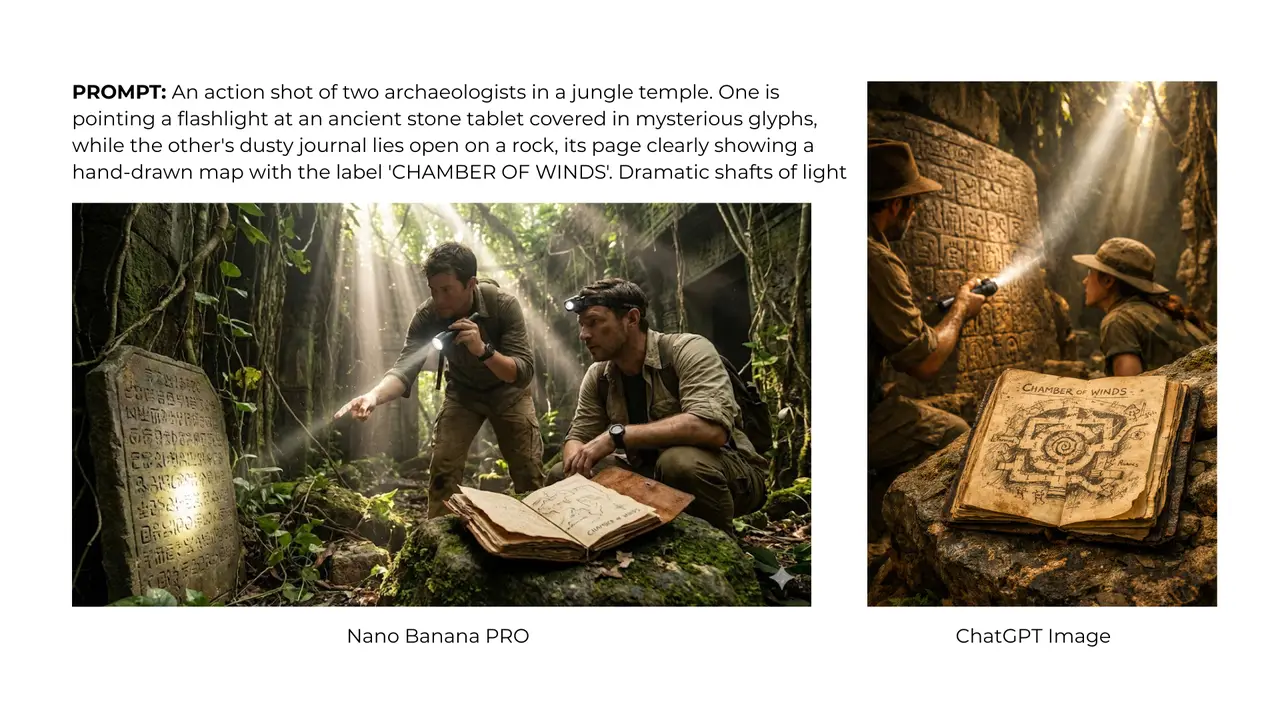
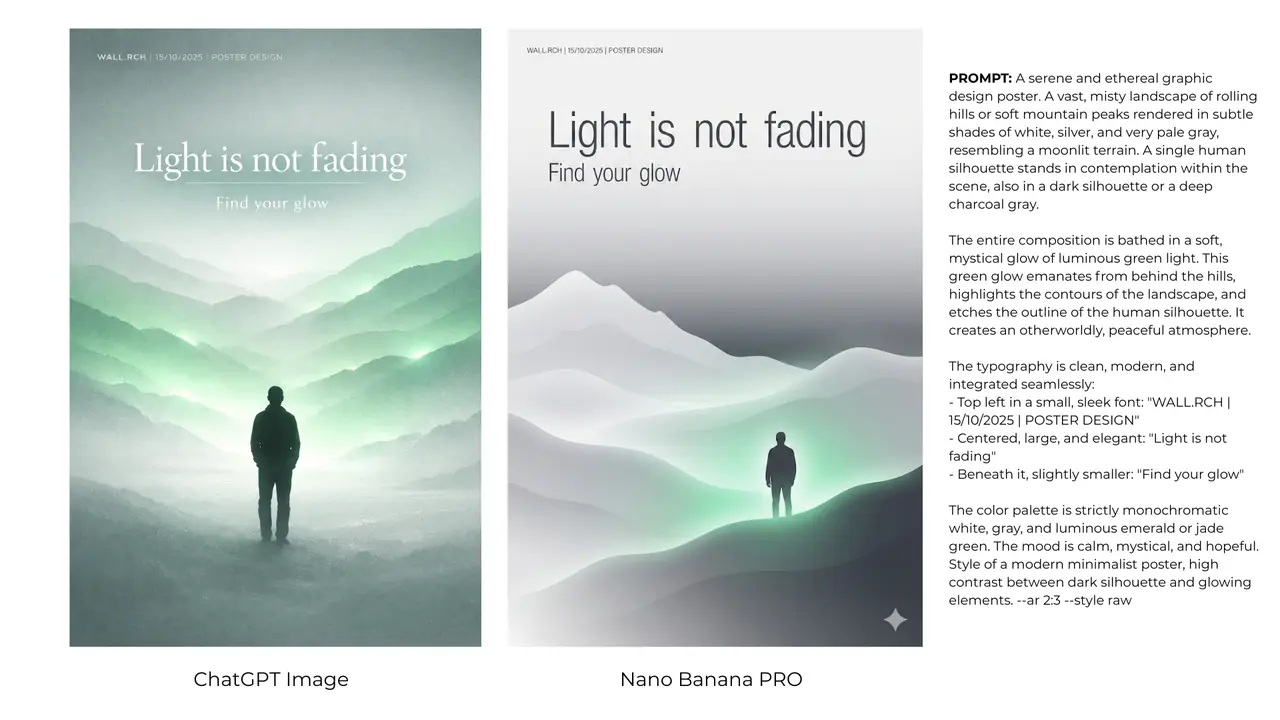
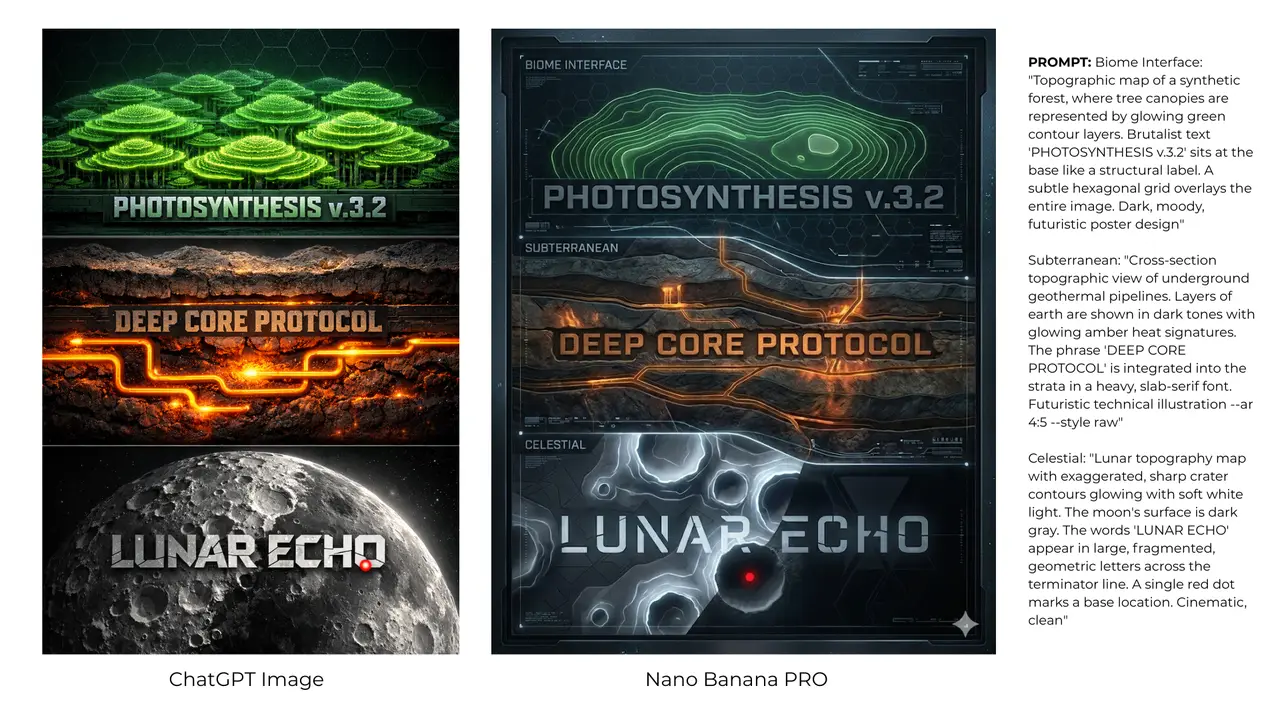
Nano Banana Pro and ChatGPT Image Same Prompt Output Comparison
Act II: Capabilities, What Each Does Best
ChatGPT Image. Narrative Visuals Through Conversation.
Powered by GPT Image 1.5, a native multimodal model that blends text and images in the same neural space, making image generation feel like dialogue.
Precise Prompt Adherence. ChatGPT Image understands context and instruction flow, preserving important elements like composition and identity across edits.
Editing in Chat. You can upload an image and ask for changes, smaller regions, colors, or objects, while keeping the surrounding details intact.
Speed. Up to 4X faster than traditional diffusion-based models, making iterative creation feel more like instant sculpting than patient rendering.
Text Rendering. Much improved over older models, menus, signs, or book covers with readable text embedded are now pretty much feasible.
This is the artist who lovesconversation, turns your words into visuals while staying faithful to your instruction flow.
Nano Banana Pro. Studio-Grade Visual Engineering
Powered by Gemini 3 Pro Image, Nano Banana Pro is built to give you photo-ready output, polished, consistent, and production-oriented.
High Res and Cinematic Control. Outputs at 2K–4K resolution, with adjustable lighting, depth of field, and camera dynamics, features often missing in casual generators.
Multi-Image and Identity Consistency. Maintain character identity across multiple scenes, ideal for brands, storytelling portfolios, or product catalogs.
Text and Typography Rendering. Supports multilingual, clear text even in complex graphics like marketing assets.
Real-World Grounding. Certain versions integrate Google search to anchor visuals in data or real information.
Fast Iteration. Typical generation times are shorter (10–20 s on rapid workflows), which pays off when you need multiple versions quickly.
Nano Banana Pro is the studio's creative director, bringing professional tools into the generative AI playground.
Nano Banana Pro and ChatGPT Image Same Prompt Output Comparison
Act III: Where They Stand Out Most. Use Cases and Why They Matter
ChatGPT Image is Best For:
Conversational Workflows and Rapid Prototyping. Because it lives inside your chat, you talk your way to the picture, iterating without context loss.
Creative Storytelling and Illustrative Work. If you want a retro comic, a symbolic infographic, or a playful doodle with sharp details, ChatGPT Image answers in style.
Editable Asset Generation. Change one element without blowing up the rest, something early text-to-image models struggled with.
This is where conversation meets vision and where you get evolving ideas.
Nano Banana Pro is Best For:
Professional Campaign Artifacts. High-resolution marketing visuals, product hero shots, consistent visual branding across assets.
Complex Scene Composition. Multiple characters, cinematic lighting, and realistic depth are all part of its wheelhouse.
Text-Heavy Visuals. Infographics, signage, schematics, Banana doesn’t trip over typography.
Real-World Grounding. Google’s upstream data gives a subtle contextual anchor that ChatGPT Image doesn’t inherently possess (yet?).
For pro designers, advertisers, and brand storytellers, this feels less like a “toy” and more like a creative workstation.
Act IV: Limits. Where They Trip Over Their Own Pixels
No artist is flawless.
ChatGPT Image’s Edges
Fidelity Ceiling. While GPT Image 1.5 is impressive, ultra-high-fidelity 4K visuals, especially photographic realism, can lag behind specialized tools.
Context Limits. Very complex graphic layouts or dense diagrams can still challenge its textual reasoning.
The charm of conversational control trades off a bit of studio polish.
Nano Banana Pro and ChatGPT Image Same Prompt Output Comparison
Nano Banana Pro's Rub
Usage Limits and Throttling. Due to sky-high demand, Google has capped free use to just a few images per day, and even paid users sometimes hit dynamic limits.
Potential Instability. Some users report erratic switching between Pro and standard models or fluctuations in quality for heavy-use accounts.
Professional Focus. It’s powerful, but that power leans toward production use cases; casual creative experimentation sometimes feels slower or overkill.
In other words, the studio tool sometimes behaves like a studio with booking limits.
Act V: A Quick Decision Guide
Here’s how to pick your AI paintbrush:
Nano Banana Pro and ChatGPT Image Comparison
Both tools are excellent; they just serve different artistic missions.
Final Frame. A Gallery, Not a Game
At the end of the day, this isn’t a duel; it’s a gallery with two captivating wings. One wing lets you talk visuals into existence like a storyteller sculpting words and pictures together. The other lets you craft images with cinematic intent, high fidelity, and studio nuance.
The choice isn’t “which is better” but “which narrative you want to tell.”
If you want your model to become the third wing of the gallery, contact us, and we will tailor a perfect solution just for you!




.webp)