Discover which data labeling companies are truly ready to scale your AI projects in 2026—because not all data partners are created equal!

Discover which data labeling companies are truly ready to scale your AI projects in 2026—because not all data partners are created equal!
As AI systems move from experimentation to real-world deployment, data labeling has quietly become one of the biggest bottlenecks in machine learning. Training modern models—especially in areas like computer vision, NLP, autonomous systems, and enterprise AI—requires not just labeled data, but consistent, high-quality labels at scale.
In 2026, the question is no longer who can label data, but who can actually scale data labeling without breaking quality, timelines, or budgets. This article looks at what scaling really means in data labeling today, what separates strong vendors from fragile ones, and which data labeling companies are best positioned to support serious AI programs.
At small volumes, data labeling seems straightforward. A few annotators, a simple task definition, and a labeling tool are often enough. But as datasets grow into the hundreds of thousands or millions of samples, complexity compounds quickly.
Scaling data labeling introduces challenges around workforce management, quality control, domain expertise, and iteration speed. Label definitions evolve, edge cases multiply, and small inconsistencies can cascade into model performance issues. For high-stakes AI systems—medical imaging, robotics, finance, or autonomous driving—poor labeling can quietly undermine the entire pipeline.
This is why many AI teams discover too late that labeling is not a commodity service. It is an operational capability.
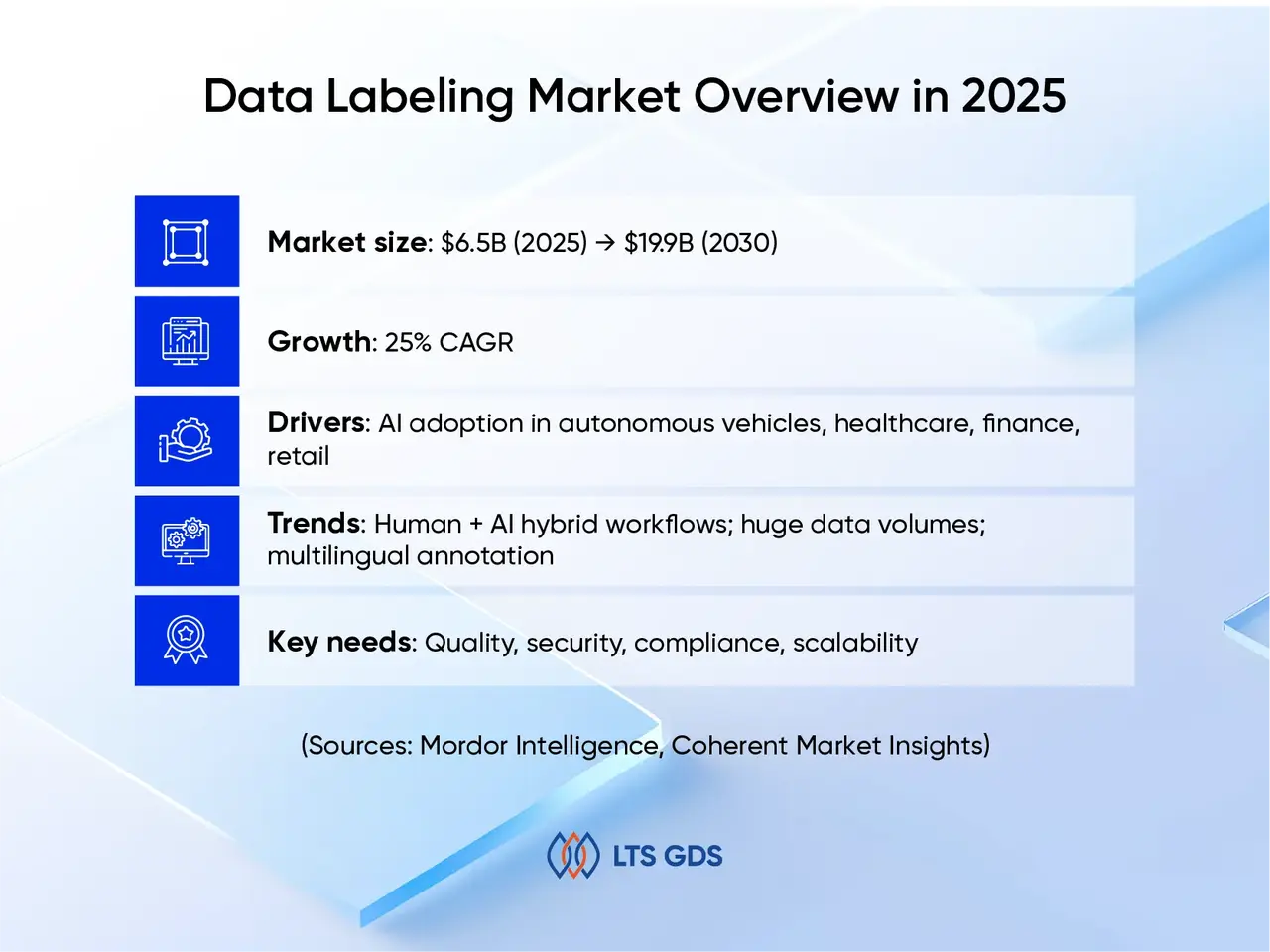
In 2026, scalable data labeling is less about raw workforce size and more about systems, processes, and feedback loops.
A scalable provider can handle changing label schemas without restarting projects. They can support multiple data modalities—text, image, video, audio, sensor data—under the same quality framework. They embed quality assurance directly into the workflow, rather than treating it as an afterthought.
Most importantly, scalable labeling vendors integrate tightly with model development. Labels are not static outputs; they are refined based on model errors, evaluation metrics, and downstream performance. Vendors that understand this loop are far better equipped to support production AI.
Before looking at specific companies, it’s important to understand what actually matters when choosing a labeling partner in 2026.
Strong providers demonstrate consistent annotation quality across large volumes, not just in pilot projects. They offer flexible workforce models that combine trained annotators, subject-matter experts, and automation where appropriate. They provide transparent quality metrics, clear escalation paths, and support iterative labeling workflows.
Equally important is domain knowledge. Labeling medical scans, financial documents, or robotics sensor data requires very different expertise. Vendors that specialize—or can credibly support multiple domains—tend to outperform generalist platforms when projects scale.
Abaka AI focuses on scalable, high-quality data labeling designed for production AI systems. Rather than offering generic annotation services, Abaka emphasizes dataset curation, domain-aware annotation, and tight integration with model evaluation.
Abaka supports complex workflows across computer vision, NLP, multimodal, and robotics data, with strong quality control pipelines and human-in-the-loop processes. Its approach is particularly suited for teams that need reliable labeling at scale while continuously iterating on models.
For organizations building long-term AI capabilities rather than one-off datasets, Abaka positions itself as a strategic data partner rather than a transactional vendor.
Biggest Advantage: Abaka’s domain-aware annotation and continuous model evaluation integration set it apart, offering highly customized datasets that evolve with AI models.
Scale AI is one of the most well-known names for data labeling, particularly in autonomous driving and enterprise AI. The company offers a large workforce, mature tooling, and strong automation capabilities.
Scale excels in high-volume labeling projects and has deep experience working with large enterprises. However, its services are often best suited for teams with significant budgets and well-defined labeling pipelines.
Biggest Advantage: Scale AI’s automation capabilities and large-scale workforce enable high-volume, consistent labeling at speed, making it ideal for projects with massive data requirements.
Labelbox combines annotation tooling with managed labeling services, making it popular among teams that want more control over their labeling workflows. Its platform is flexible and supports a wide range of data types.
While Labelbox is strong on tooling and workflow management, teams scaling to very large or highly specialized datasets may need additional operational support beyond the platform itself.
Biggest Advantage: Labelbox’s flexible platform and robust tooling provide users with more control over the labeling process, which is beneficial for teams needing tailored workflows.
Appen has a long history in data annotation and offers a global workforce capable of handling large-scale projects. It supports text, speech, image, and video labeling across many industries.
Appen’s scale is a strength, but outcomes can vary depending on project setup, quality controls, and domain complexity. Successful projects often require close collaboration and strong internal oversight.
Biggest Advantage: Appen’s massive global workforce is capable of handling complex, multi-domain projects with extensive scalability potential.
TELUS provides enterprise-focused AI data services, including data labeling, evaluation, and content moderation. Its offerings are often integrated into broader digital transformation initiatives.
This makes TELUS a good fit for large organizations looking for end-to-end managed services, though it may be less flexible for fast-moving research teams.
Biggest Advantage: TELUS International excels in providing comprehensive, enterprise-level AI services that integrate labeling with other key processes like evaluation and moderation.
Even with established vendors, many AI teams struggle to scale labeling effectively. The most common issues include unclear label definitions, insufficient feedback loops between model performance and annotation, and treating labeling as a one-time task instead of an ongoing process.
Teams that succeed typically view data labeling as part of their core AI infrastructure. They invest in documentation, tooling, and partnerships that allow them to adapt quickly as models evolve.
Abaka AI works with AI teams that need more than raw annotation throughput. Its services focus on building robust datasets that improve model performance over time, supported by structured quality control, expert annotators, and evaluation-driven iteration.
Whether you are labeling data for computer vision, language models, or embodied AI systems, Abaka helps ensure your data scales alongside your ambitions.
If you’re struggling to scale data labeling without sacrificing quality—or preparing to move an AI system into production—Abaka AI can help. Reach out to learn how our data curation, annotation, and model evaluation services support high-performing AI systems at scale.
Data labeling is the process of assigning meaningful annotations to raw data—such as images, text, audio, or video—so that machine learning models can learn from it. These labels act as ground truth during training and evaluation.
The right data labeling company depends on your data type, domain complexity, scale requirements, and quality expectations. Look for vendors with proven experience in your domain, strong quality controls, and the ability to iterate as your models evolve.
Automation plays an important role in scaling data labeling, but fully automated labeling is rarely sufficient for complex or high-stakes AI systems. Human-in-the-loop approaches remain critical for accuracy, edge cases, and validation.
Data labeling costs vary widely depending on data type, complexity, volume, and required expertise. While low-cost labeling may work for simple tasks, investing in quality labeling often leads to better model performance and lower downstream costs.
Auto Data Labels in Machine Learning: Benefits, Limits, and Use Cases
What are the Best Tools for Automating Structured Data Labeling in 2025
Abaka AI vs Surge AI: Comprehensive AI-Powered Data Labeling and Content Moderation Platform
Forbes. (2026). The AI talent wars have hit data labeling. Retrieved from Forbes
Averroes AI. (2026). Best data labeling companies. Retrieved from Averroes AI
F6S. (2026). Data labeling & annotation companies. Retrieved from F6S
GDS Online. (2026). Top data labeling companies. Retrieved from GDS Online
Labellerr. (2026). How to choose the right data labeling company. Retrieved from Labellerr

Missing data

We collect it.

Messy data
We label it.

No time
We have itOff-The-Shelf.
Pick the closest fit, we'll take the call from there.
Missing data
We collect it.
Messy data
We label it.
No time
We have it Off-The-Shelf.
Pick the closest fit, we'll take the call from there.