Top Annotation Tools in 2025: A Complete Guide with Abaka Forge Compared
Tatiana Zalikina,Director of Growth Marketing
Behind every “wow-this-model-is-smart” moment sits a battalion of annotation tools quietly scrubbing, shaping, and arguing with raw data. It is like a backstage pass to the gear that makes magic; messy, powerful, and occasionally a little too proud of itself. In this article we will explore the best annotation tools for your model!
Top Annotation Tools in 2025: A Complete Guide with Abaka Forge Compared
Have you ever wondered which tools do the heavy lifting behind the clean dataset → smart AI magic? Data-annotation tools for machine learning are like a workshop where canvas, paint, and light come together. Some are humble brushes; others are power drills. Let’s stroll through the best...with honest pros, cons, and a bit of soul.
What makes a “best” annotation tool anyway?
Before we dive into names, here’s what matters (with some cold-hard metrics and real needs):
Flexibility of data types: images, video, text, LiDAR, medical scans, whatever your ML model dreams of.
Automation + human-in-the-loop (HITL): AI pre-labels, humans correct because humans still catch nuance better. Hyper link to our own article
Scalability & collaboration: teams working together, workflows, QA, versioning, export into ML-friendly formats.
Accuracy + speed trade-off: you don’t want speed at the cost of junk labels; you don’t want perfect labels that take forever.
Integration into ML pipelines: SDKs, APIs, export formats like COCO/YOLO/PASCAL, so that annotation feeds seamlessly into training.
If a tool hits most of these boxes, it’s already playing in the “top shelf.”
Various Annotation Tools
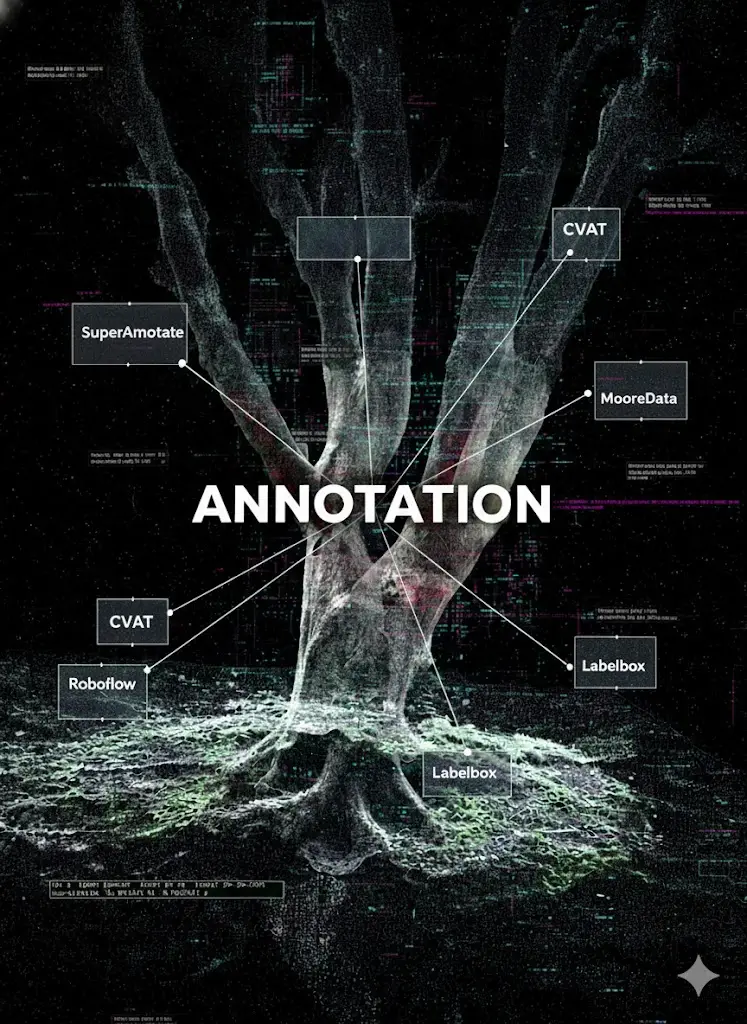
Some of the Heavy-Hitters: Annotation Platforms Worth Considering in 2025
Here are several of the best data annotation tools for ML, each with its own flavor
Enterprise-grade & full-stack champions
Labelbox — A go-to for big teams juggling images, text, video, audio, geospatial data, and everything in between. Offers AI-assisted pre-labeling, flexible workflows, real-time quality control, easy collaboration and strong API/SDK support.
SuperAnnotate — Great when you work heavily with image/video data or even LiDAR/point-clouds. Strong automation tools, good for large volumes, and built-in quality-check workflows make it a solid choice when precision and team coordination matter.
Open-source/self-hosted/budget-conscious picks
CVAT (Computer Vision Annotation Tool) — The classic free tool, originally built by Intel, widely used by teams who want control. It supports object detection, segmentation, video and image annotation, and exports to common formats. Perfect if you're technically comfortable, don’t mind DIY hosting, or need customizability.
Roboflow — A developer-friendly platform especially suited for computer vision projects. Offers quick annotation + preprocessing + export + even training pipelines if needed. Nice for rapid prototyping, smaller projects, or flexible iterations.
And then there’sAbaka Forge (Abaka AI): the “all-in-one studio that grows with you”
If your data aspirations range not only from classic 2D images to 3D point clouds but even to 4D spatio-temporal streams, and you want a unified, scalable, flexible annotation + data-ops backbone, take a closer look at Abaka Forge. Given what we know from inside the newsroom (Yes, slightly biased, but still), it rightfully owns a seat at the table among the “top shelf.”
What Abaka Forge offers (and why you may care):
Support for 2D image annotation, — bounding boxes, semantic segmentation (masks), keypoints, even standard video-frame annotation when needed. Good for classic vision tasks.
Support for 3D/point-cloud data annotation — 3D boxes, semantic segmentation on point clouds, lane/line/ROI annotation, useful for robotics, autonomous driving, or any sensor-fusion project.
4D annotation — spatio-temporal: when data isn’t just “what is where,” but “what moves when + where.” Temporal sequencing, dynamic scenes, sensor fusion over time.
Multimodal support — image, video, point clouds, sensor data, even text/audio when relevant (depending on project).
AI-powered annotation + human-in-the-loop review + quality control workflows — auto-labeling to accelerate throughput, followed by human review to ensure quality and consistency.
Scalability and pipeline integration — from raw data ingestion, through cleaning, annotation, QA, to output ready for model training;
What this breadth means: You don’t have to swap tools when your project evolves. Start with 2D image classification. Later you add lidar + video + temporal behavior. Abaka Forge is built to handle that growth. You get consistency, fewer tool-switch headaches, pipeline reliability.
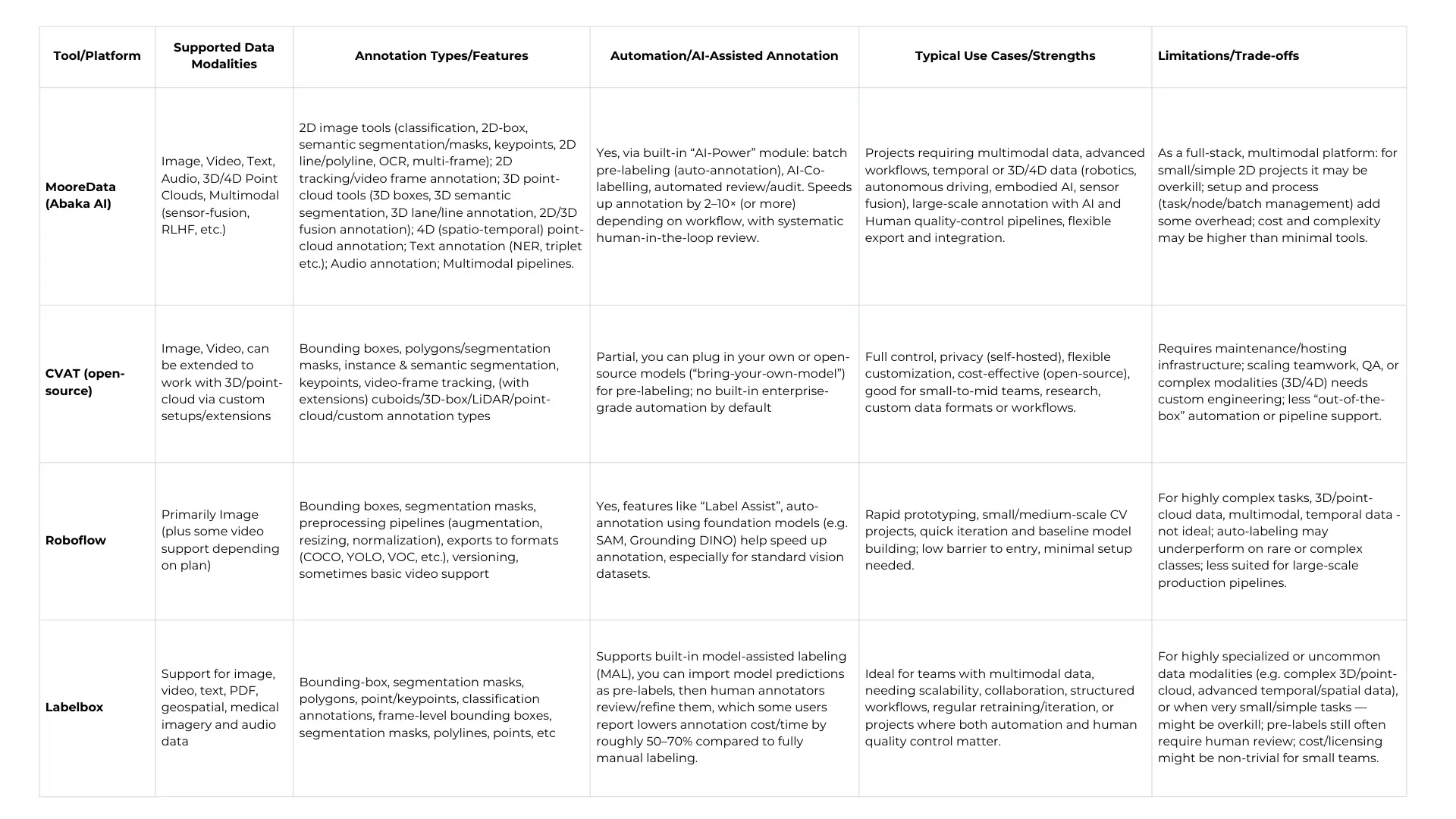
Annotation Tools Comparison
Annotation-Tool Comparison Matrix (2025)
Quick Thoughts: Where Abaka Forge Stands Out and Where to Be Practical
Best fit: If your project deals with complex data such as 2D images and 3D point clouds and/or video, maybe even sensor-fusion or temporal sequences, Abaka Forge gives you a unified platform. You don’t need to juggle multiple tools.
When speed + scale + quality control matter: The built-in “AI-Power” module makes a big difference, automated pre-labeling, co-labeling, batch-level review + audit, reducing manual burden while keeping quality.
Future-proofing: Even if you start small (e.g., simple 2D images), Abaka Forge can scale as your needs grow (3D, 4D, multimodal, RLHF, etc.).
Trade-offs: For small, simple projects, using open-source or lightweight tools may be more cost-efficient and simpler. Abaka Forge’s full suite may be overkill if you don’t need multimodal or 3D/4D workflows.
The annotation tool you choose shapes how deeply your model sees — shallow shadows, or full-on motion picture. Choose wisely, build carefully, and the difference isn’t only in accuracy or speed; it’s in the soul of your AI. Contact us to see what is the best fit for your project!
What's your data bottleneck this quarter?
Missing data
We collect it.
Messy data
We label it.
No time
We have itOff-The-Shelf.
Pick the closest fit, we'll take the call from there.