AI-Powered Data Annotation Technologies: Improving Efficiency and Accuracy at Scale
Alexandra Bezea-Tudor,Marketing Specialist
As AI systems grow more complex and data volumes increase, manual data annotation has become a major bottleneck for building reliable, production-scale models. AI-powered, human-in-the-loop annotation pipelines enable faster, more consistent, and scalable labeling, especially for complex datasets across multiple modalities.
AI-Powered Data Annotation Technologies: Improving Efficiency and Accuracy at Scale
High-quality labeled data is the foundation of every successful AI system. Yet as models grow more complex and data volumes expand, traditional manual annotation has become one of the most significant bottlenecks in AI development. AI-powered data annotation technologies are reshaping this process by automating repetitive tasks, improving consistency, and enabling scalable, production-ready data pipelines.
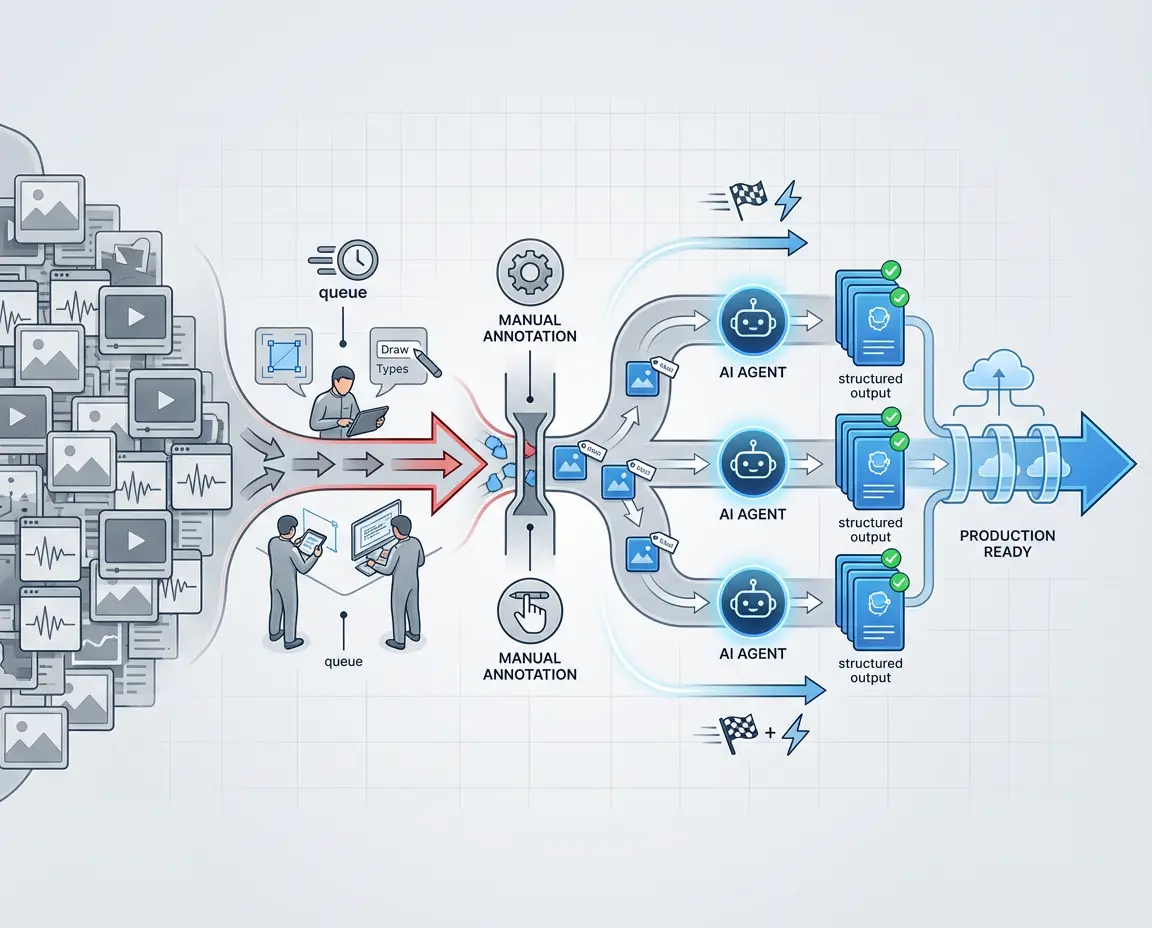
AI Agents embedded in data labeling workflows are increasingly used to address annotation bottlenecks, particularly for complex and large-scale datasets, by improving speed, consistency, and scalability.
AI data annotation bottleneck illustration
Why Data Annotation Is Critical in AI Development
Data annotation transforms raw data into machine-readable training material, which by nature, is a very labor-intensive process. Industry analyses show that data-related work, including collection, cleaning, labeling, and validation dominates AI project timelines. A widely cited industry estimate by Cognilyticanotes that AI teams may spend up to 80% of their time on data preparation tasks, including annotation.
Poor data quality is also a leading barrier to successful AI deployment. The McKinsey's State of AI report (2025)highlights that while many organizations are rapidly adopting generative AI, most have not yet redesigned workflows or built the robust data infrastructure needed to move beyond pilots and achieve enterprise-level impact. Academic research further reinforces the risk of poor data quality, withSui et. al (2025) finding that training on datasets with noisy labels can cause significant model performance degradation.
These challenges are amplified in high-stakes domains such as healthcare and autonomous systems, where annotation errors can directly impact safety. As AI adoption accelerates, manual-only annotation approaches increasingly limit both speed and scalability.
How AI-Powered Data Annotation Increases Efficiency at Scale
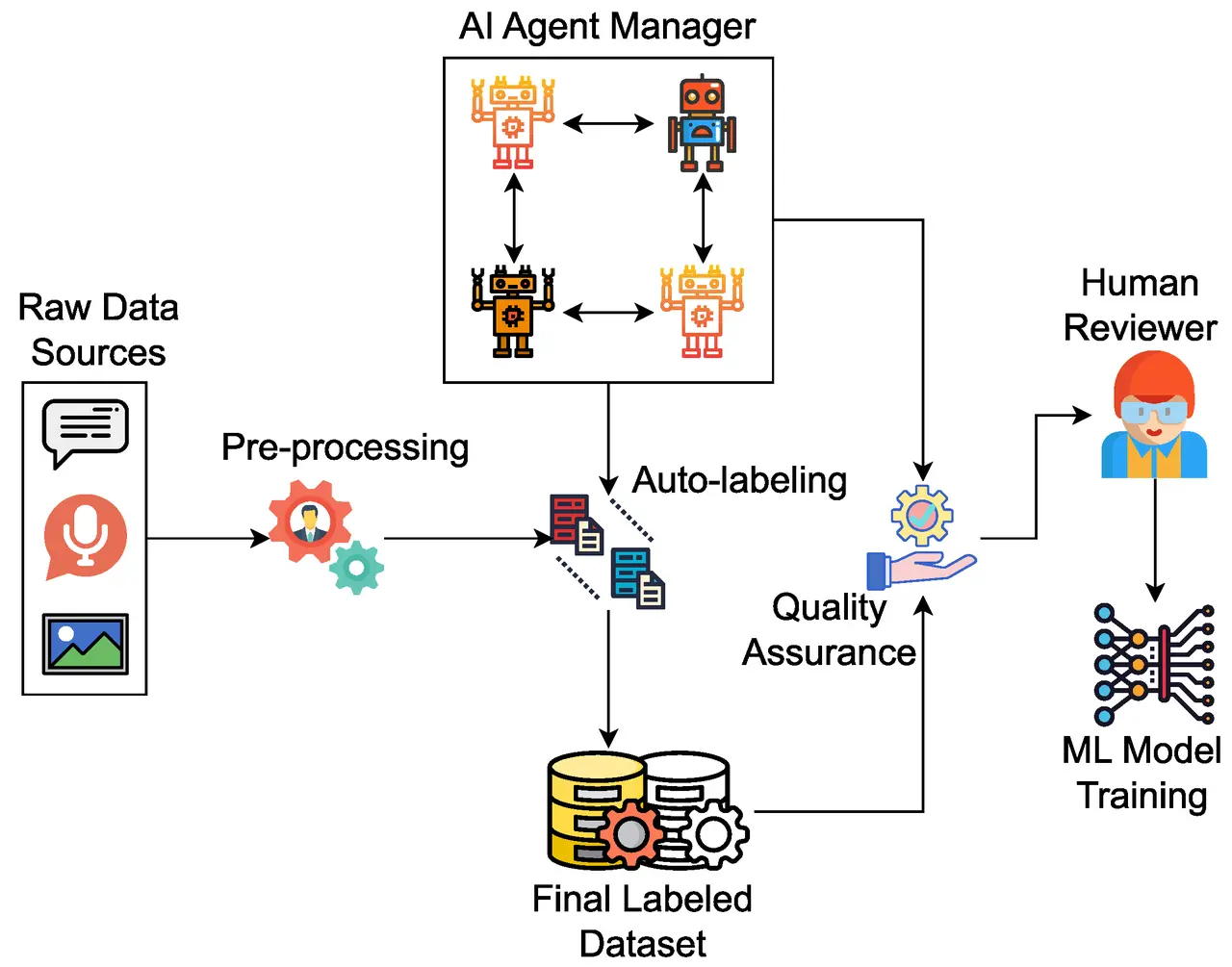
AI-powered annotation systems address these constraints by introducing automation directly into the labeling workflow. Using pre-trained models, these systems generate initial labels that human reviewers can validate or refine. This approach can increase throughput compared to fully manual annotation.
Peer-reviewed research supports these gains.Karim et. al (2025) highlights that AI agent-based approaches, including model-assisted annotation and active learning techniques, can reduce human labeling effort, time, and costs by 50–74% (with some systems achieving up to 80% in specific controlled scenarios) while maintaining accuracy comparable to or exceeding human-level performance. This shifts annotation from static, batch-based work to continuous, iterative pipelines that support incremental model updates and faster iteration cycles.
Industry reports further highlight the urgency of scalable annotation strategies. The global AI annotation market is projected to grow from USD 1.96 billion in 2025 to USD 17.37 billion by 2034, driven by increased demand for high-quality labeled data for AI applications (Precedence Research, 2025).
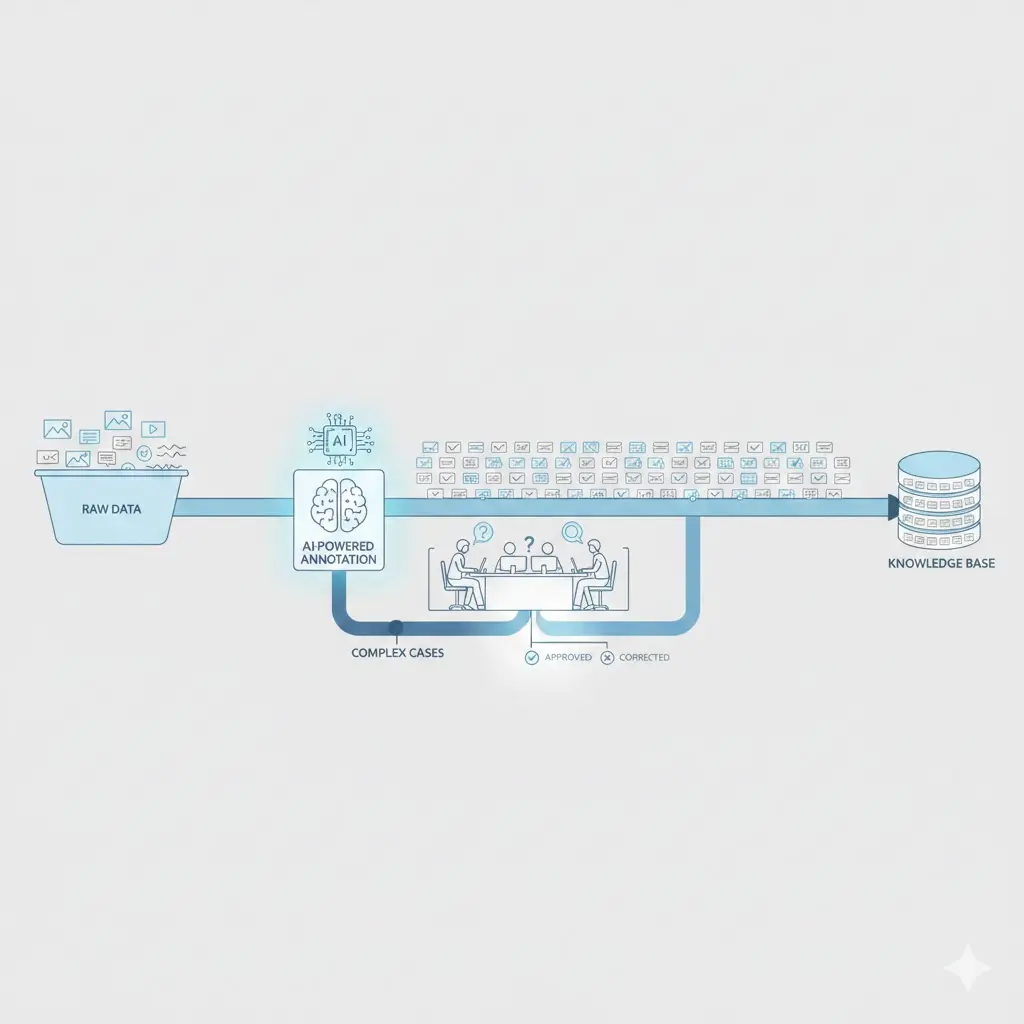
These efficiencies enable teams to process massive datasets in the range of millions of images to continuous sensor streams, while allowing human experts to focus on complex or ambiguous cases.
AI handling large-scale annotation with humans reviewing complex cases
How AI Improves Annotation Accuracy While Supporting Human Experts
Contrary to common misconceptions, AI-powered annotation augments rather than replaces human expertise through human-in-the-loop (HITL) systems. These combine AI's efficiency in repetitive labeling with human judgment for validating outputs, resolving ambiguities, and handling edge cases. It is also helpful in reducing annotator fatigue and improving consistency.
The paper of Karim et. al (2025) highlights how inconsistencies from human factors like fatigue and cognitive bias can compromise dataset quality, leading to suboptimal performance. The paper also notes risks from AI-only approaches, such as hallucinations (e.g., large language models introducing non-existent findings in generated chest X-ray summaries). HITL workflows mitigate these risks via oversight mechanisms like escalation to expert review, automated quality checks, and iterative feedback loops. These safeguards ensure accuracy in high-stakes domains such as medical diagnosis and autonomous driving.
Why Advanced and 4D Data Requires AI-First Annotation Pipelines
As AI systems advance, so does the data they rely on. Modern applications increasingly depend on multimodal and spatio-temporal (4D) data, combining 3D space with time. Autonomous vehicles, robotics, and smart environments require annotations that maintain strict consistency across frames, sensors, and viewpoints to enable reliable perception and decision-making.
Manual methods struggle with these requirements. Tracking objects across time, maintaining spatial alignment, and synchronizing multiple data modalities demand precision that is difficult to sustain at scale without automation. The Stanford AI Index Report 2025 documents the rapid advances in multimodal AI models and broader deployment of AI systems, highlighting the critical need for sophisticated data infrastructure to support their development.
AI-powered pipelines address these challenges by automating object tracking, enforcing temporal consistency across frames, and flagging annotation errors early. These capabilities are essential for production-grade 4D datasets.
How Abaka AI Delivers Scalable and Accurate Data Annotation
Abaka AI helps teams working with complex, large-scale datasets by providing an AI-powered annotation pipeline designed for efficiency, accuracy, and scale. Abaka AI integrates automation, quality control, and human expertise into a unified workflow optimized for production use.
What sets Abaka AI apart:
Comprehensive annotation support – including Image, 3D/4D Point Cloud, RLHF, Text, Video, and more
Faster annotation – AI-driven pre-labeling to accelerate throughput without sacrificing accuracy
Expert HITL oversight – 1M+ specialized annotators across 50+ countries ensure quality at scale
Native 4D data support – Enables spatial and temporal consistency in point cloud workflows
Built-in quality control mechanisms– Automated quality checks and multi-tier verification catch errors early