Shallotpeat vs Gemini 3: OpenAI’s Unreleased Challenger Explained (2026 Preview)
Alexandra Bezea-Tudor,Marketing Specialist
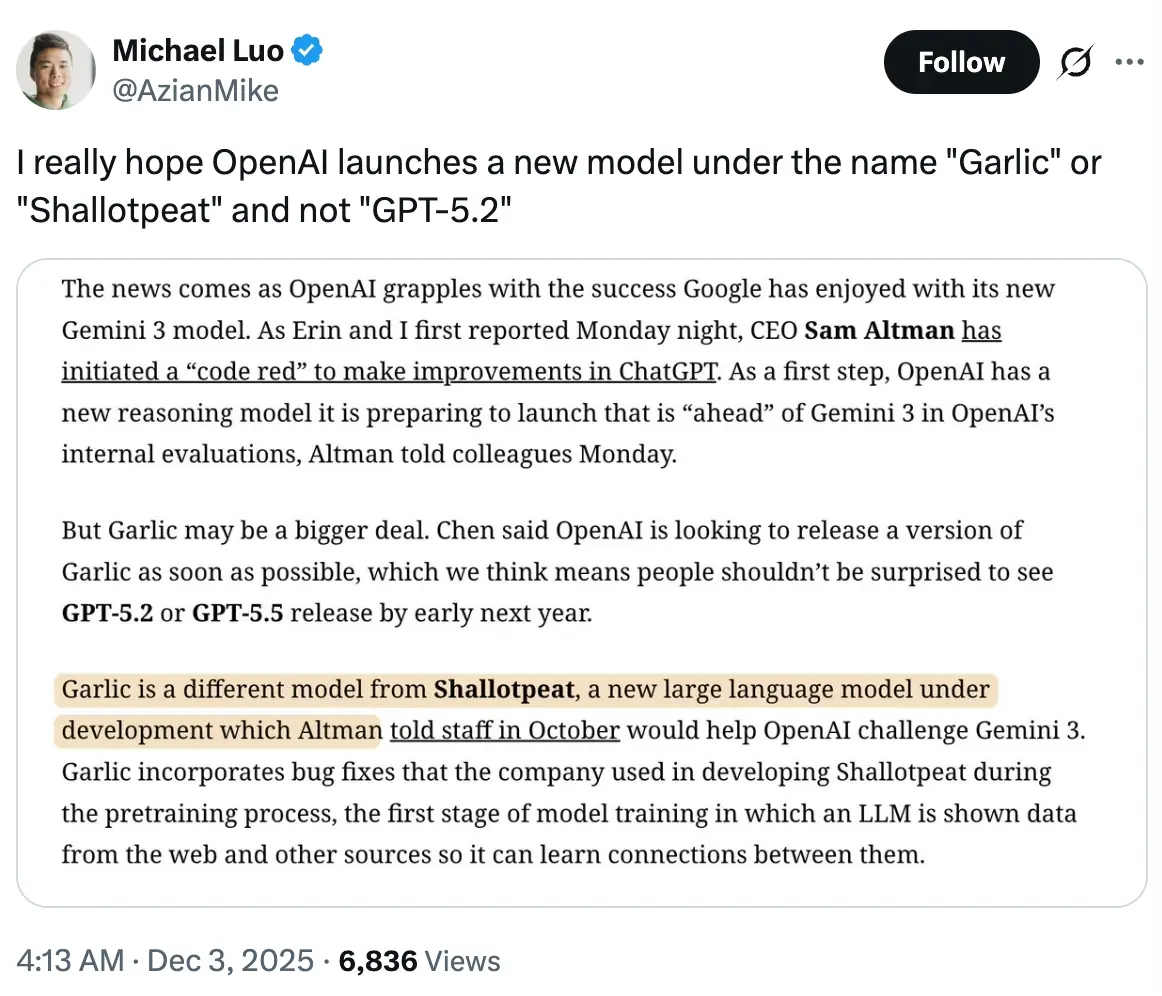
OpenAI is reportedly developing an internal project codenamed Shallotpeat, potentially aimed at challenging Google’s Gemini 3. While technical details remain undisclosed, industry reports suggest it could address pre-training limitations and restore OpenAI’s competitiveness in large-scale AI models.
Shallotpeat Isn’t Even Out Yet—But Already Being Compared to Gemini 3
Shallotpeat vs Gemini 3: AI competition heats up
OpenAI's Project Shallotpeat: The Answer to Gemini 3?
Shallotpeat is reported as an internal OpenAI codename for a forthcoming AI model. Its name metaphorically signals a “counteracting” effort, reflecting the development team’s focus on addressing pre-training deficiencies noted in internal memos. While technical specifications remain undisclosed, memos and industry coverage suggest Shallotpeat is aimed at restoring OpenAI’s competitiveness against rivals like Google.
According to reports, Shallotpeat is being developed to address bugs encountered during pre-training, an area where Google’s Gemini 3 has recently excelled. In an internal memo, Altman noted that Google’s recent AI advances may create economic headwinds for OpenAI. The available reporting indicates that Shallotpeat is indeed an actively developed project, though the public has yet to see official releases or benchmarks. The codename itself symbolizes OpenAI tackling difficult training challenges to improve foundational model performance.
Shallotpeat could be OpenAI’s challenger to Gemini 3
How Does Gemini 3 Fit Into the Current AI Landscape?
Google’s Gemini 3 currently sets a high benchmark for large-scale, multimodal AI models. Reports highlight its advanced performance in reasoning, native multimodality, and agentic capabilities, outperforming GPT-5.1 on top AI benchmarks. Because Gemini 3 is fully public, benchmarked, and widely adopted, it naturally becomes the reference point for evaluating new models, even those not yet released.
These comparisons are driven by competitive pressure and strategic context, rather than confirmed performance. Analysts note that OpenAI may need to close the gap through speed, functionality, and efficiency, similar to a chess game where the next move can alter market dominance.
Who Will Be Affected and Future Outlook
Enterprise IT departments, product planners, and developers may see direct implications from Shallotpeat’s eventual release. Organizations might need to reassess tool selection, budgeting, and staffing strategies in response to shifting AI performance standards.
Shallotpeat is expected to be released in early 2026, according to multiple sources. However, information is still fragmented, and the model’s precise capabilities remain unclear. The global AI community is closely monitoring upcoming announcements to see how OpenAI will leverage Shallotpeat to stay competitive in the evolving landscape of large-scale AI models.