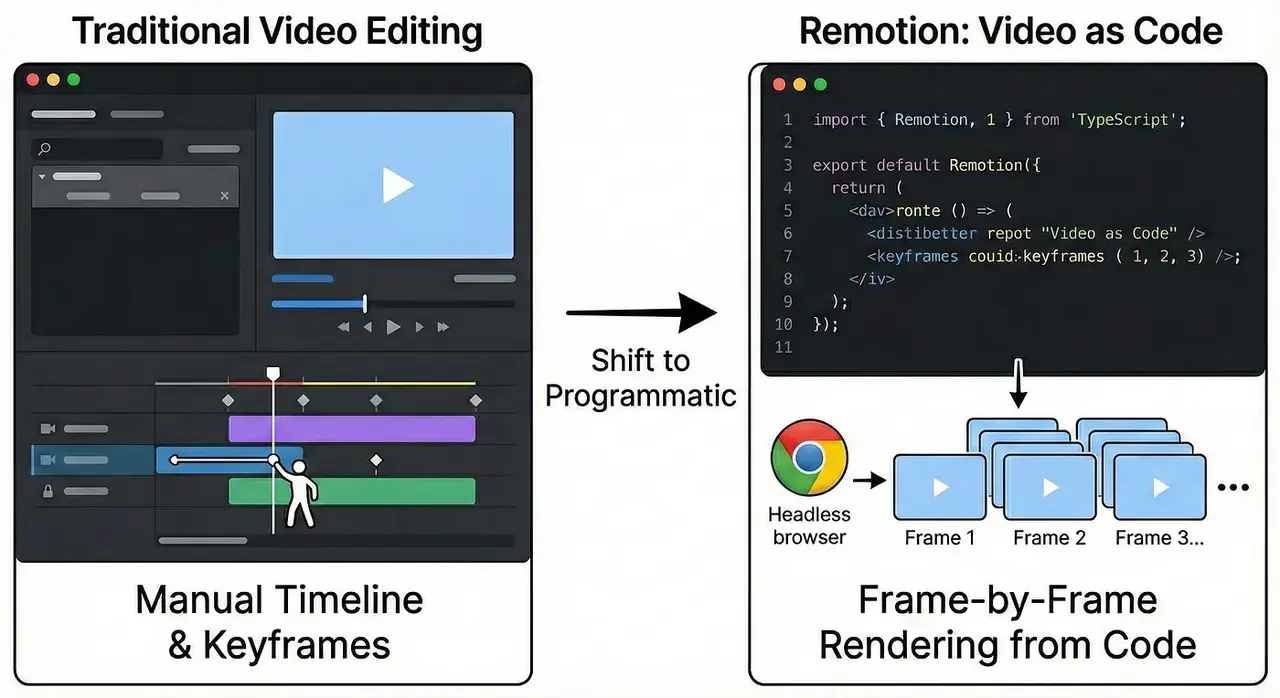
The traditional video editing "craft" of scrubbing timelines in Premiere or After Effects is being replaced by programmatic command. Remotion Skills is the catalyst for this shift, allowing AI agents like Claude Code to generate, edit, and render pixel-perfect videos directly from text prompts.By treating video as React code rather than a "black box" generation, Remotion Skills offers Abaka AI users a deterministic, version-controlled, and highly scalable way to bridge the gap between natural language and professional-grade video delivery.
No Premiere, No After Effects: Remotion Skills Turns Prompts into Videos
Why Remotion Skills Suddenly Matter
For years, Remotion has existed as a niche developer library for "writing" videos with React.However, the release of Remotion Skills provides AI agents with a "mental model" of video structure—scenes, timing, and composition.
Deterministic vs. Generative: Unlike typical AI video models that often suffer from visual "hallucinations" or temporal warping, Remotion Skills generate actual source code. This ensures every frame is exactly where it should be, allowing for 100% reproducible results and pixel-perfect edits.
Mass Customization: Because the video is code-driven, you can feed personalized user data (such as "Year-in-Review" statistics) into a single prompted template to render thousands of unique videos automatically. This level of scale is impossible with traditional manual editing.
Iterative Editing at Scale: Forget tedious feedback loops. You can simply tell the AI to "make the logo transition 0.5s faster" or "apply the new brand colors site-wide". The AI modifies the underlying code and re-renders the asset in seconds.
The "Prompt-to-React" Workflow
Video production now mirrors the software development lifecycle, turning creative work into an industrial assembly line:
The Skill Module: You equip an AI agent with the Remotion Skills knowledge unit via npx skills add remotion-dev/skills, enabling it to reason about frames and components.
Strategic Prompting: You describe the scene requirements in natural language. The AI writes specific React components and complex animation logic instead of just guessing pixels.
Headless Rendering: Using a headless browser (like Puppeteer), the system captures every frame as a high-resolution screenshot. These are then compiled by FFmpeg into a fluid, professional MP4.
Version Control: Since the video is coded, projects are managed via Git. You can roll back changes, manage branches for different platforms, and collaborate as a dev team rather than a solo editor.
The Power of Systemic Synergy (Multi-Skill Integration)
The true value of Remotion Skills is unlocked when it is paired with other specialized AI "Skills" in a unified ecosystem. At Abaka AI, we see video not as an isolated asset, but as the final output of a coordinated AI pipeline:
Needs Analysis (Brainstorming Skill): Use specialized brainstorming skills to turn fuzzy marketing ideas into structured video requirements (style, duration, copy, and rhythm) before the first line of code is written.
Design Enhancement (UI-UX-Pro-Max Skill): Combine Remotion with design-focused skills to upgrade basic "slideshow" animations into high-end UI/UX walkthroughs featuring skeuomorphic elements and streamer effects.
Iteration Management (Task Board): Use a task board skill to execute sequential updates—such as fixing text overlaps or adjusting GIF speeds—ensuring the AI agent completes the "last 10%" of polish that often separates demos from production assets.
Final Thoughts: Friction is the Only Bottleneck
Abaka AI team believes that "Environmental Realism" is key to AI success. Applying this to video, Remotion Skills allow us to move from toy demos to production-ready assets:
Product Demos (15–60s): High-speed iteration for landing pages and feature launches.
Data Visualization: Turning complex spreadsheets into animated, easy-to-digest charts.
Social Media Shorts: Rapidly adapting core messages for TikTok, Reels, or LinkedIn with brand-consistent typography.
Remotion Skills doesn't replace storytelling; it removes friction. For teams that cannot afford the high costs and slow cycles of traditional post-production, this shift represents a move toward Industrialized Creativity. In 2026, the best "editors" won't be the ones with the fastest mouse; they'll be the ones with the clearest prompts.
What's your data bottleneck this quarter?
Missing data
We collect it.
Messy data
We label it.
No time
We have itOff-The-Shelf.
Pick the closest fit, we'll take the call from there.