Best NLP Data Labeling Companies & Platforms in 2026
Jessy Abu Khalil,Director of Sales Enablement
Compare NLP data labeling platforms and services — NER, sentiment, intent, document, chatbot, and LLM/RLHF annotation. See how Abaka AI delivers expert, human-in-the-loop NLP data labeling at scale.
Best NLP Data Labeling Companies & Platforms in 2026
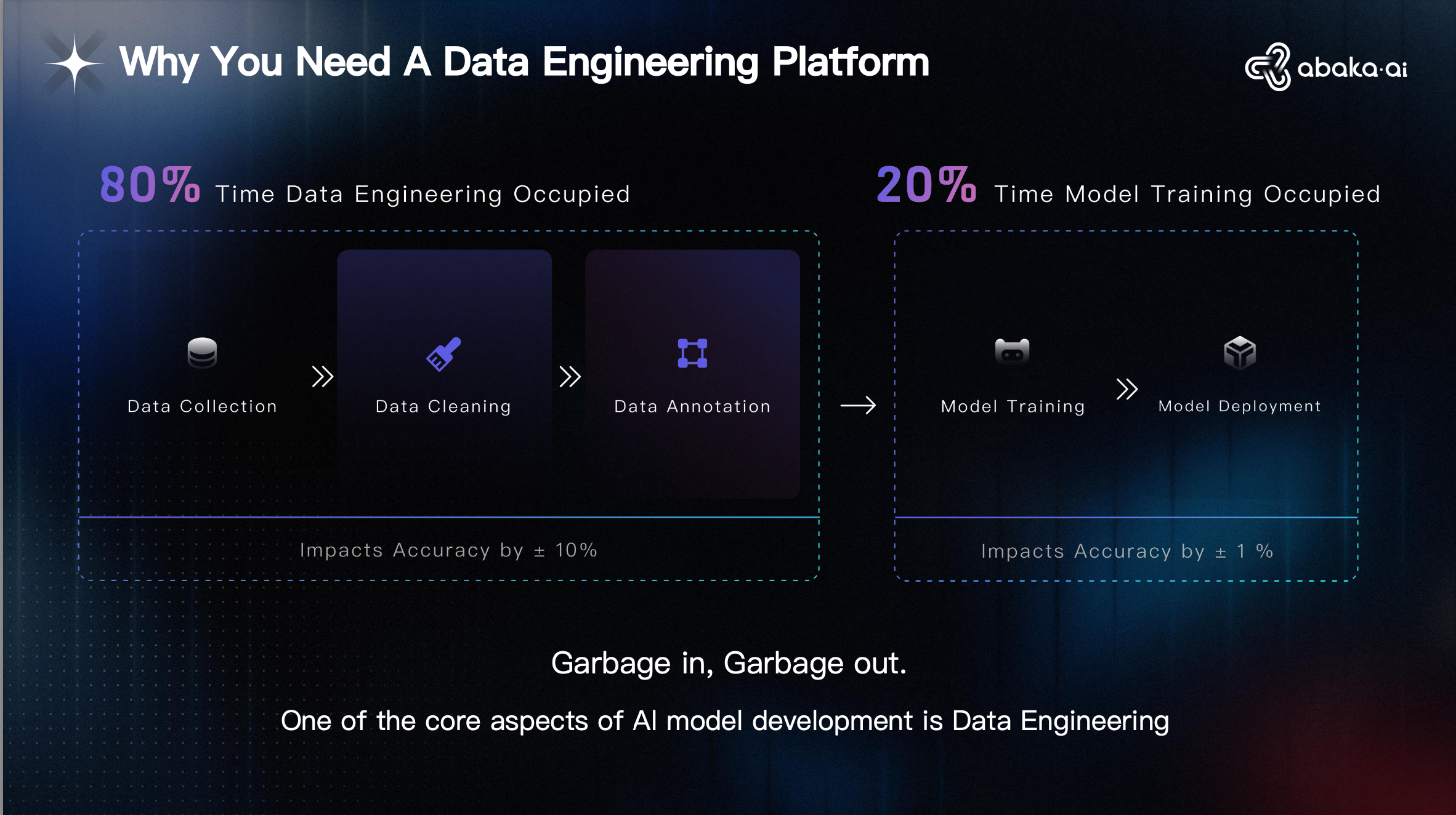
Your NLP model can't tell a careful label from a rushed one — it just learns from whichever one it gets. Inconsistent labels produce an inconsistent model. So a major bottleneck in NLP projects can be the NLP data labeling feeding the model.
The difference between good and bad training data-your model can tell
What actually distinguishes a good NLP data labeling platform is whether the team behind it understands the nuance of language — NER, intent detection, multi-turn dialogue — not just the volume it can push through. Some platforms lean on scale, others on precision; the ones worth using balance automation with expert human review and hold up under complex taxonomies or multilingual input.
Frustrated with data that doesn't quite fit? Or NLP data labeling services that leave your model behaving strangely for reasons nobody can explain? Poor-quality or mismatched training data can contribute to these problems — and closing that gap is what NLP data labeling services are for.
Abaka AI runs that process end to end: NLP training data services for real-world applications, from domain-specific jargon to multilingual and code-switched text, with tooling and human expertise working together rather than one standing in for the other.
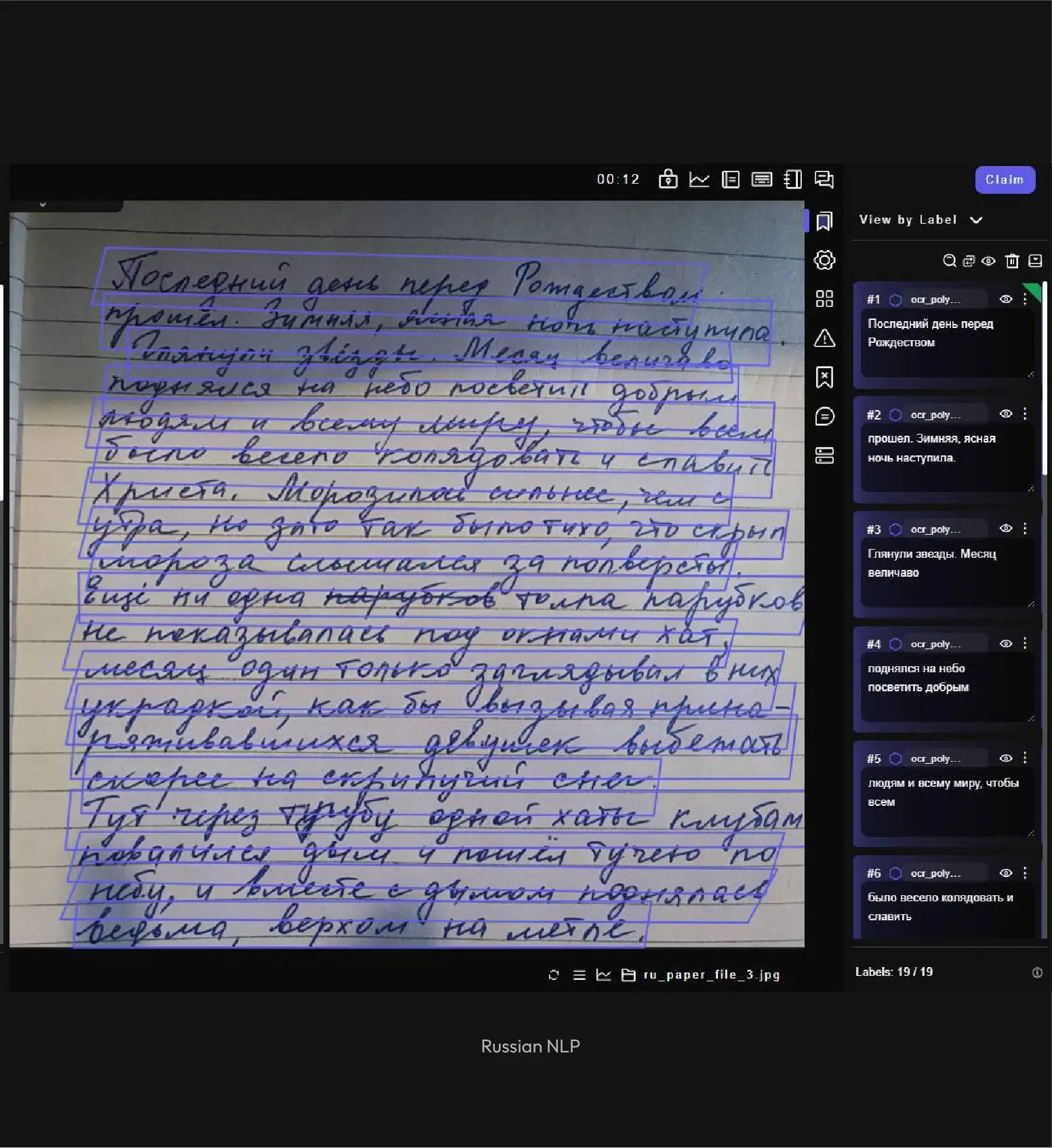
Russian-language handwritten text transcribed and labeled inside the Abaka Forge platform
Free, open-source Community Edition; customizable labeling interfaces and self-hosting
Early-stage or cost-sensitive teams building their own pipeline
Which NLP data labeling service do you actually need?
"NLP data labeling" covers a wider range of work than most teams expect. The foundation layer is general-purpose NLP data annotation and text data labeling — classification, tagging, and extraction from raw text, what most people mean by natural language data labeling and text annotation services before the task gets more specific. From there, data labeling for NLP splits into the task types Abaka actually handles:
NER annotation — tagging people, organizations, locations, dates, and domain-specific entities across legal, medical, and financial text (NER annotation services, NER data labeling, named entity recognition annotation)
Sentiment analysis — reviews, support tickets, and social text, from simple positive/negative/neutral to fine-grained emotion and aspect-level sentiment (sentiment analysis data labeling)
Intent classification — mapping utterances to the action behind them for support routing, chatbots, and voice assistants (intent classification data labeling)
Chatbot & conversational AI training data — multi-turn dialogue, intents, and response quality, tracked across turns rather than one message at a time (chatbot training data services)
LLM training data labeling & annotation — instruction data, response ranking, rubric scoring, and preference pairs for post-training (LLM training data labeling, LLM data annotation services)
Custom NLP dataset creation — sourcing, generating, and structuring text from scratch when nothing existing fits your domain or language (NLP dataset creation)
Human-in-the-loop expert labeling — domain-aware reviewers for the cases where context or subjective judgment affects the correct label (human-in-the-loop NLP data labeling)
Abaka Forge platform access — workspace-level access to Abaka Forge for review, QA dashboards, and export
What to assess before choosing a provider
Start with the task, not the pitch. Ask a provider how they'd label an ordinary example, an ambiguous one, and a genuine edge case from your own data. That reveals more than a general accuracy claim.
Also worth checking: how they update guidelines, how they measure inter-annotator agreement, how disagreements get resolved, whether they cover your languages and output formats, and how they handle volume changes without loosening QA.
A representative pilot tests most of this before a larger engagement begins.
When to use a platform, and when to outsource
An internal platform can make sense once you already have annotators, project managers, and subject-matter experts in place, with time to maintain guidelines and QA as the taxonomy shifts.
More often, the practical answer is a dedicated NLP data labeling company, especially with multiple languages, specialist review needs, or volume that fluctuates. Some engagements combine managed data labeling for NLP with direct platform access rather than treating the two as an either/or choice.
As an NLP data labeling provider, here's what that looks like with Abaka specifically:
Full task coverage: NER, sentiment, intent, chatbot, and LLM/RLHF annotation under one engagement
Expert review at scale: a human-in-the-loop network of 1M+ specialized annotators across 50+ countries
Flexible engagement: full NLP data labeling outsourcing, or workspace access to Abaka Forge if you want to run more of the process yourself; Forge also supports image, video, and 3D/4D point cloud data on the same platform
AI data labeling for NLP at scale: automation-assisted pre-labeling with human QA applied on top.
Whether it's one dataset or an ongoing NLP annotation services engagement, a dedicated NLP annotation company takes the tooling decision off your plate. For teams seeking NLP labeling services or data labeling services for NLP across multiple tasks, Abaka covers the range above under a single engagement.
FAQs
Q1: What's the difference between NLP data labeling and NLP data annotation?
In practice, the terms are interchangeable. Both mean attaching structured labels, such as entities, sentiment, intent, or categories, to text.
Q2: What NLP tasks does Abaka AI cover?
NER, sentiment, intent, chatbot, and LLM training data labeling including RLHF, delivered as standalone NLP data annotation services or one combined engagement.
Q3: Do I need a different vendor for LLM/RLHF data versus standard NLP labeling?
Not necessarily. A provider can handle both, provided it has the right annotators, workflows, and quality controls. RLHF preference data requires reviewers trained to compare model responses against clear evaluation criteria. Abaka offers these workflows alongside NER, sentiment, and intent annotation within one engagement.
Q4: What's human-in-the-loop labeling, and do I actually need it?
It means human review sits alongside automation, with people checking or correcting suggested labels. Expert review matters especially where mislabeling is costly, such as medical, legal, or financial text. The level of review needed depends on task complexity and quality requirements.
Q5: Can Abaka build a dataset from scratch, or only label data I already have?
Both. NLP dataset creation covers building new datasets from scratch, and annotation services cover labeling data you already hold.