How do robots and AI systems learn to navigate the real world? This article takes you behind the scenes of data analysis and annotation pipelines, the unsung heroes that help AI see, think, and act.

How do robots and AI systems learn to navigate the real world? This article takes you behind the scenes of data analysis and annotation pipelines, the unsung heroes that help AI see, think, and act.
Embodied AI systems, whether the name rings familiar or not, are already on their way to invade our societies, in the form of robots, autonomous vehicles, and smart assistants. These systems rely heavily on data analysis and efficient annotation pipelines to understand their environments, make decisions, and perform tasks autonomously. Data analysis enables these systems to process vast amounts of sensory information, while annotation pipelines ensure that the data is properly labeled for machine learning.
This article explores the crucial roles of data analysis and annotation pipelines in embodied AI systems, drawing on insights from recent research and industry advancements.
Unlike traditional AI, which operates within virtual or static contexts, embodied AI systems interact with the world through sensors and actuators and are defined by their physical presence. This makes them highly dependent on real-time data. Examples of this real-life interaction include robots navigating spaces, self-driving cars perceiving traffic, and drones avoiding obstacles.
Data analysis plays a crucial role in these systems by helping them interpret complex sensory inputs, adapt to environmental changes, and make informed decisions. The relationship between model architecture and task-specific performance is governed by scaling laws, which allow for more informed design choices in robotic systems (Agal & Odedra, 2025). These laws suggest that data-driven approaches can achieve remarkable reliability, with success rates exceeding 95% in controlled environments, and 92% in real-world conditions, paving the way for industrial deployments (Agal & Odedra, 2025).
Embodied AI systems collect and process a wide variety of data types, each playing a crucial role in their functionality:
Sensory Data: Includes inputs from cameras, microphones, touch sensors, and accelerometers. This data is fundamental for perception and navigation.
Environmental Data: Provides information about the surroundings, such as spatial data from LIDAR, depth cameras, or 3D maps.
Interaction Data: Captures feedback from human-robot or robot-environment interactions, crucial for training AI systems to respond to dynamic contexts.
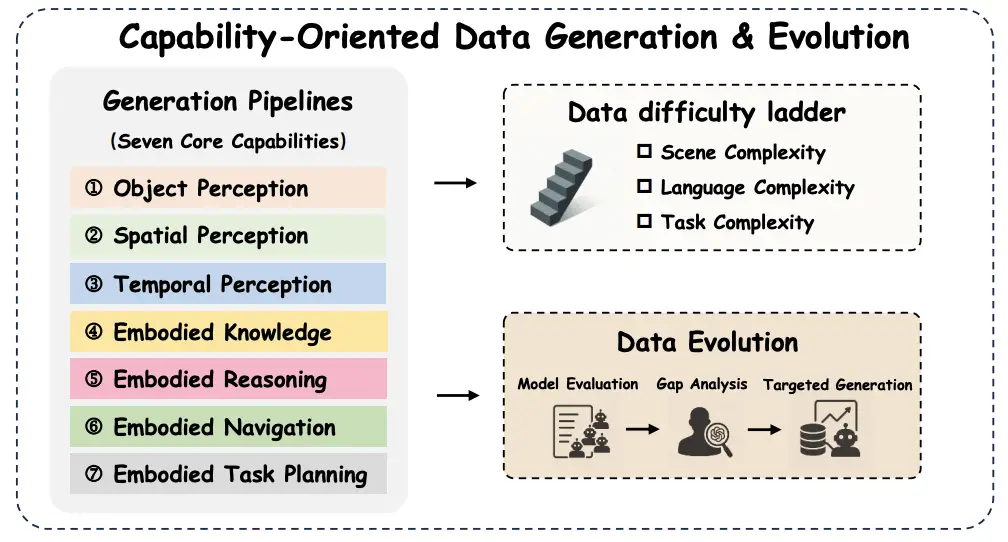
Before raw data can be utilized, it must undergo several preprocessing steps to ensure it is suitable for machine learning:
Noise Reduction: Sensors often produce noisy data that can obscure meaningful patterns. Filtering techniques are used to remove irrelevant or erroneous data.
Normalization/Standardization: Data from multiple sources may have different scales, making it essential to standardize or normalize them to ensure consistent analysis.
Feature Extraction: Raw data is often too complex to use directly. Feature extraction identifies the most important aspects of the data (e.g., key objects in images or significant movements in motion data).
Data Fusion: Embodied AI systems often rely on data from multiple sensors. Data fusion integrates these data streams into a coherent representation of the environment, improving decision-making and reducing uncertainty.
Data analysis, like in any other field, is at the heart of training AI to learn from its environment and make intelligent decisions. Techniques such as reinforcement learning and supervised learning rely heavily on high-quality data to enable systems to recognize patterns, make predictions, and adapt to new situations. Given the highly dynamic and unpredictable nature of real-world environments, AI systems must constantly process data and adjust their behavior accordingly.
Annotation is the process of labeling data to help train machine learning models. As we mentioned earlier, in embodied AI systems, data comes from a variety of sensors and modalities, which require accurate and consistent annotations. If we are dealing with an efficient annotation pipeline, this means that the raw data is labeled, structured, and ready for use in training algorithms.
Annotation pipelines are essential for supervised learning, where AI models are taught to recognize patterns based on labeled data. In the context of embodied AI, these pipelines need to accommodate a wide range of data types, from 3D point clouds to interaction logs.
Data Collection: Data is collected from a variety of sources, including cameras, sensors, and human feedback. This data must be organized and prepared for the next steps.
Preprocessing: Raw data often needs to be cleaned and transformed. Preprocessing tasks may include noise removal, data transformation, and segmentation of large datasets.
Annotation: This step involves labeling the data, either manually or with the help of algorithms. In embodied AI, annotations could include object detection in images, spatial labeling in 3D environments, or tagging interaction data.
Quality Control: Ensuring the accuracy and consistency of annotations is crucial. This can be done through manual review, automated verification algorithms, or cross-checking annotations by multiple annotators.
Robust annotation pipelines for embodied AI come with several challenges that must be addressed seriously.
The first major challenge is scalability. The large volumes of data generated by sensors in real-time environments can overwhelm manual annotation efforts. Automating data labeling is essential to manage the scale required for industrial applications (Liu, 2024).
The second important factor is data complexity. Not only is the volume of data massive, but the multimodal nature of the data generated by embodied AI systems makes it difficult to label accurately. For example, annotating 3D data or dynamic interaction logs requires specialized expertise and tools (Lu & Tang, 2023).
Furthermore, maintaining consistent annotation quality is a significant challenge, particularly when using multiple annotators or integrating data from diverse sources. Ensuring accuracy and uniformity in annotations is crucial for the performance of the trained models.
To overcome these challenges, a number of practices are at our disposal. First, we could automate repetitive tasks. AI algorithms come in handy with the assistance they can offer in the annotation process, such as automatically detecting objects or classifying actions in sensor data. This reduces the time and cost associated with manual labeling (Lu & Tang, 2023).
The second practice to consider is iterative annotation. As embodied AI systems interact with dynamic environments, annotations should be updated and refined over time to account for changes in the environment and system behavior (Zhang et al., 2025).
Lastly, annotation is not a one-person venture. Collaboration across teams is a crucial aspect of it. Building effective annotation pipelines requires open communication between data scientists, domain experts, and engineers to ensure that data is labeled appropriately and in alignment with system requirements.
Data analysis and annotation pipelines are fundamental components of embodied AI systems. Through effective data processing, fusion, and labeling, these systems can learn from real-world interactions, adapt to new environments, and perform complex tasks autonomously. As the field of embodied AI continues to evolve, improving data analysis techniques and streamlining annotation pipelines will be critical to the scalability and success of these systems. By addressing the challenges of data quality, scalability, and consistency, we can unlock the full potential of embodied AI in diverse industries, from robotics to healthcare (Liu, 2024; Agal & Odedra, 2025).
At Abaka AI, we specialize in dataset curation, data annotation, and model evaluation services, helping you build the high-quality data needed for your AI projects to thrive.
Ready to optimize your annotation pipeline? Book a Demo with Abaka AI.
Agal, S., & Odedra, N. D. (2025). Data science in embodied artificial intelligence and robotics: A comprehensive study of models, methods, and applications. Embodied Intelligence and Robotics, 025200005.
Liu, S. (2024, April 16). The Value of Data in Embodied Artificial Intelligence – Communications of the ACM. Acm.org.https://cacm.acm.org/blogcacm/the-value-of-data-in-embodied-artificial-intelligence/
Lu, Y., & Tang, H. (2025). Multimodal data storage and retrieval for embodied ai: A survey. arXiv preprint arXiv:2508.13901.
Ni, F., Zhang, M., Li, P., Yuan, Y., Zhang, L., Liu, Y., ... & Hao, J. (2025). Embodied arena: A comprehensive, unified, and evolving evaluation platform for embodied ai. arXiv preprint arXiv:2509.15273.
Zhang, Y., Tian, J., & Xiong, Q. (2025). A review of embodied intelligence systems: a three-layer framework integrating multimodal perception, world modeling, and structured strategies. Frontiers in Robotics and AI, 12, 1668910.
Q1: What is the biggest challenge in data analysis for embodied AI systems?
A1: One of the biggest challenges is dealing with the complexity and volume of data that embodied AI systems generate. These systems often rely on multimodal data which must be processed, integrated, and analyzed effectively. Ensuring data quality, managing sensor noise, and ensuring that the AI can adapt to real-world environments are significant hurdles. Additionally, ensuring that data analysis is scalable across different platforms and environments adds further complexity (Lu & Tang, 2023).
Q2: Why is an effective annotation pipeline crucial for embodied AI?
A2: An annotation pipeline is essential because it prepares raw data for training AI models. Since embodied AI systems rely on accurate data labeling to learn, an efficient pipeline ensures that the data is consistently annotated, which directly impacts the performance and reliability of the AI system. Without well-annotated data, models may fail to recognize objects or behaviors correctly, leading to poor performance, especially in dynamic and complex real-world environments (Liu, 2024).
Q3: What are some best practices for creating annotation pipelines for embodied AI?
A3: Some best practices include automating repetitive annotation tasks using machine learning algorithms, ensuring iterative annotation as new data is collected, and maintaining collaboration across interdisciplinary teams to refine and improve annotations. Additionally, leveraging semi-automated tools for complex data types, such as 3D spatial data, can significantly enhance efficiency and reduce the error rate in the labeling process (Zhang et al., 2025).
Q4: How can embodied AI systems scale given the challenges of data annotation?
A4: Scaling embodied AI systems requires automated data generation and annotation processes to handle large datasets effectively. Developing systems that can automatically generate diverse scenarios for training and testing, along with using scalable annotation platforms, is critical for overcoming bottlenecks. In addition, strategies like crowdsourcing and leveraging expert systems can help ensure that data is accurately labeled at scale, especially for complex or high-precision tasks (Liu, 2024).

Missing data

We collect it.

Messy data
We label it.

No time
We have itOff-The-Shelf.
Pick the closest fit, we'll take the call from there.
Missing data
We collect it.
Messy data
We label it.
No time
We have it Off-The-Shelf.
Pick the closest fit, we'll take the call from there.